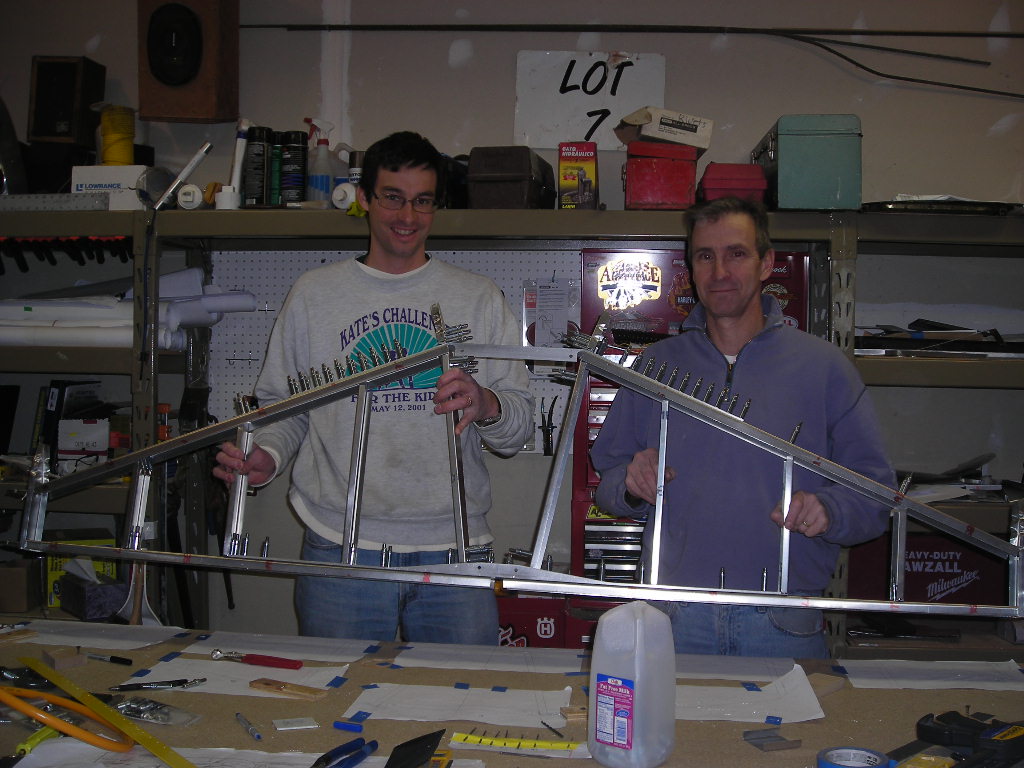
August 6, 2011 The horizontal stabilizer is hung on the wall

Looks beautiful to me.

Building An Airplane From Plans
August 6, 2011 The horizontal stabilizer is hung on the wall
Looks beautiful to me.
Dan finished riveting the frame together. He put the skins on with clecos:


Here is a close up of the leading edge, looks really nice. I am glad our tech councilor suggested to get a good bend on the leading edge.

Here is the leading edge looking from the outboard side:

Here is the training edge with the hinge:

Just before staring to rivet

One skin side flush riveted:

Here is the completed Horizintal Stabilizer:

Dan noted that you have to really have the rivet gun square/flat with the skin or the rivet might become tipped a little in the dimple. Only a couple had to be drilled out.
After admiring our work and gloating for a minute we hung it on the wall.
We assembled the complete horizontal stabilizer frame and skins one last time to make sure all the parts were in the right place.


We started with the (rear) main spar assembly (SNX-T3-01). The inner rivets are fine, but the outer ones are closer to the flange so you cannot get the rivet gun in there without deflecting the flange

Dan had previously made some spacers to put between the rivet head and the rivet gun. We decided to make a new spacer with a smaller bore to fit the rivet stem better. We had some 3/8 rod and we cut off a piece and drilled a hole. The first two attempts had the hole off center and it looked really bad. The next one was too tall and the gun could not grip the stem. The fourth one finally worked.

It’s amazing how much time these little side exercises take up. We finished riveting the main spar.

We started on the front spar (SNZ-T03-05).
However we decided t rivet SNX-T04-01 (the inner ribs) to SNX-T03-05, forward root clip. The plans show to rivet this later with assembling the whole frame, but it looks more cramped and awkward to get a rivet puller in there.

On the front spar we were careful of the orientation of the inner most rivets, the first rows (on each side) are flipped from the rest.
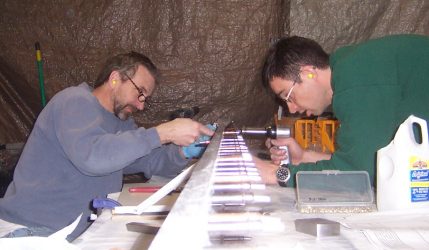
Dan primed the horizintal stabilizer parts and skins. We had gotten a gallon of 3M Mar Hyde Self Etch Primer. Dan used his compressed air paint spray gun. He has a lot more control over the spray width and delivery than with the spray cans we’ve used so far. He put a really nice light and consistant coat on, great job. Safety notes: Dan used a respirator with cartriges and had the workspace venting with a fan pulling air out a window.


Dan dimpled the hoizintal stab frame and skins and I finished preparing the frame parts for priming.
We found a used DRDT-2 dimpler for sale on the Vans Air Force website last fall and used it with a 120 degree pop rivet dimple die from Avery (We also evaluated the Cleveland die and the results are the same.) The DRDT-2 made the dimpling go really fast, but there are a few places that cannot fit (notice just below the die on the bottom beam in the picture).

Dan had modified a pair of large vice lock pliers. A freind welded on some smal channel to the jaws. The top channel has a hole for the male die half. The lower channel has a 120 degree counter sink hole with a through hole for the male die pin, essentially Dan replicated the female side of the dimple die in the lower channel. We’ll post a picture. It works really well, fits in all the tight corners on flanges.
I prepped the frame parts for priming by roughing them up with 240 grit sandpaper to take the shine off and get some swirls. I would finish up with maroon Scotchbite pad. Lots of surfaces to cover.

Dan used the same method from the vertical stab tip for the horizontal tips. However we decided to rivet the tips since we don’t think we will need to pull them off. So Dan created a strip of sheetmetal that mounts between the skin and the frame and extends out under the tip.
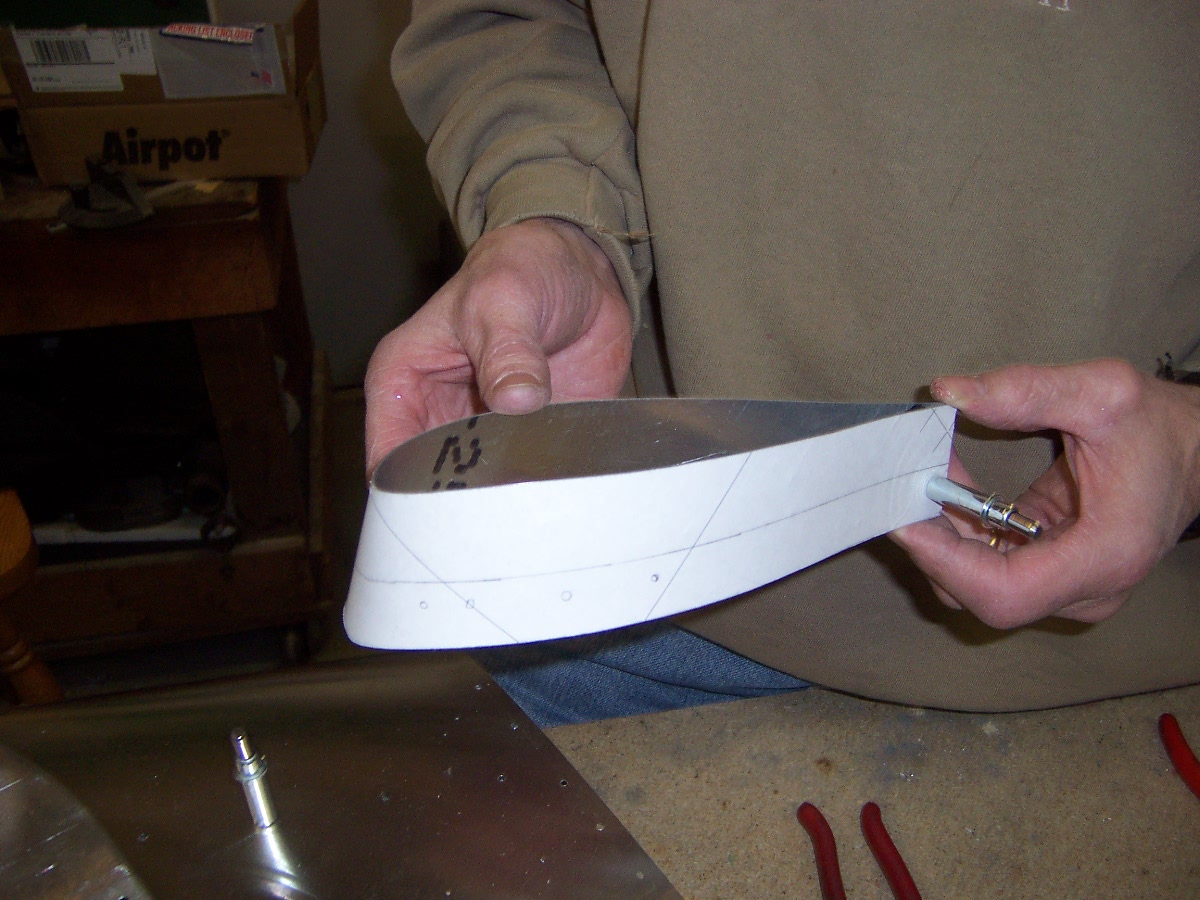
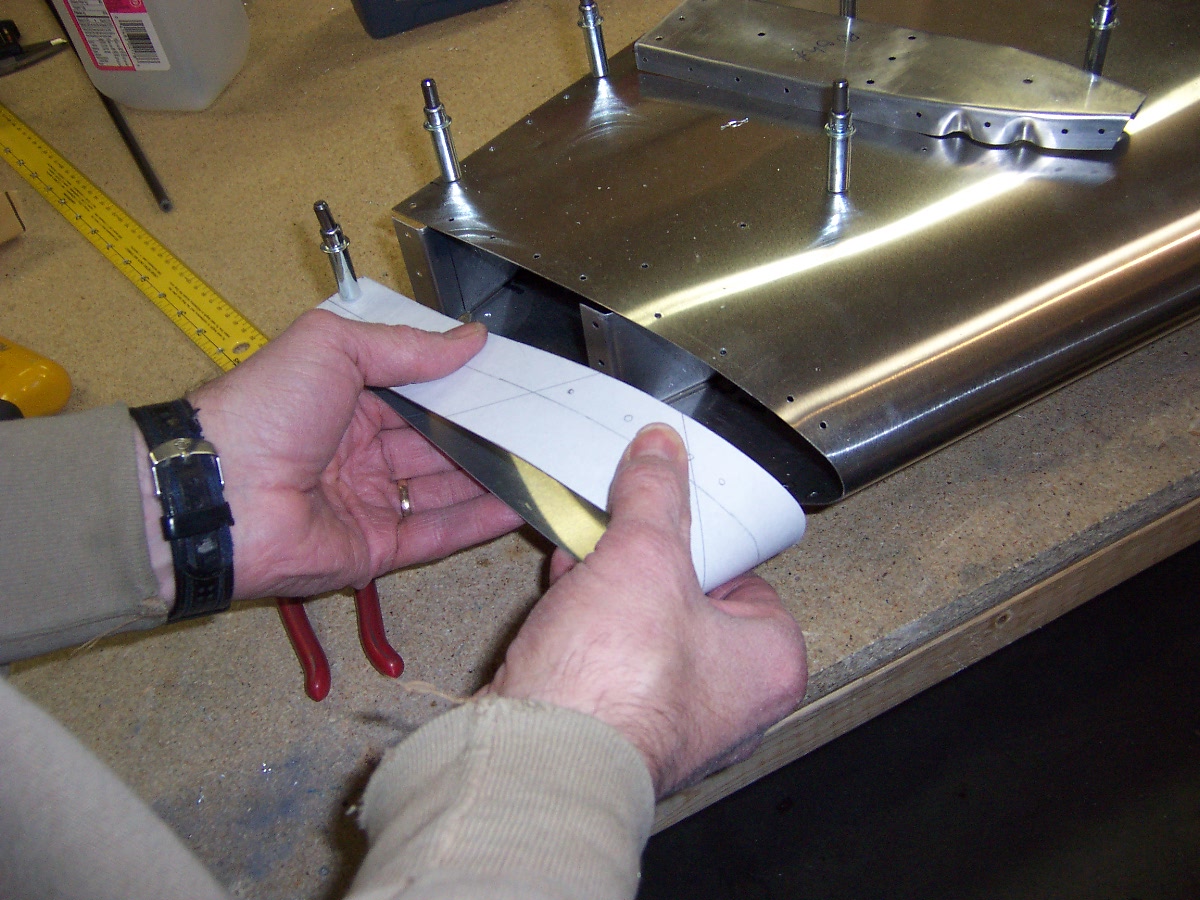
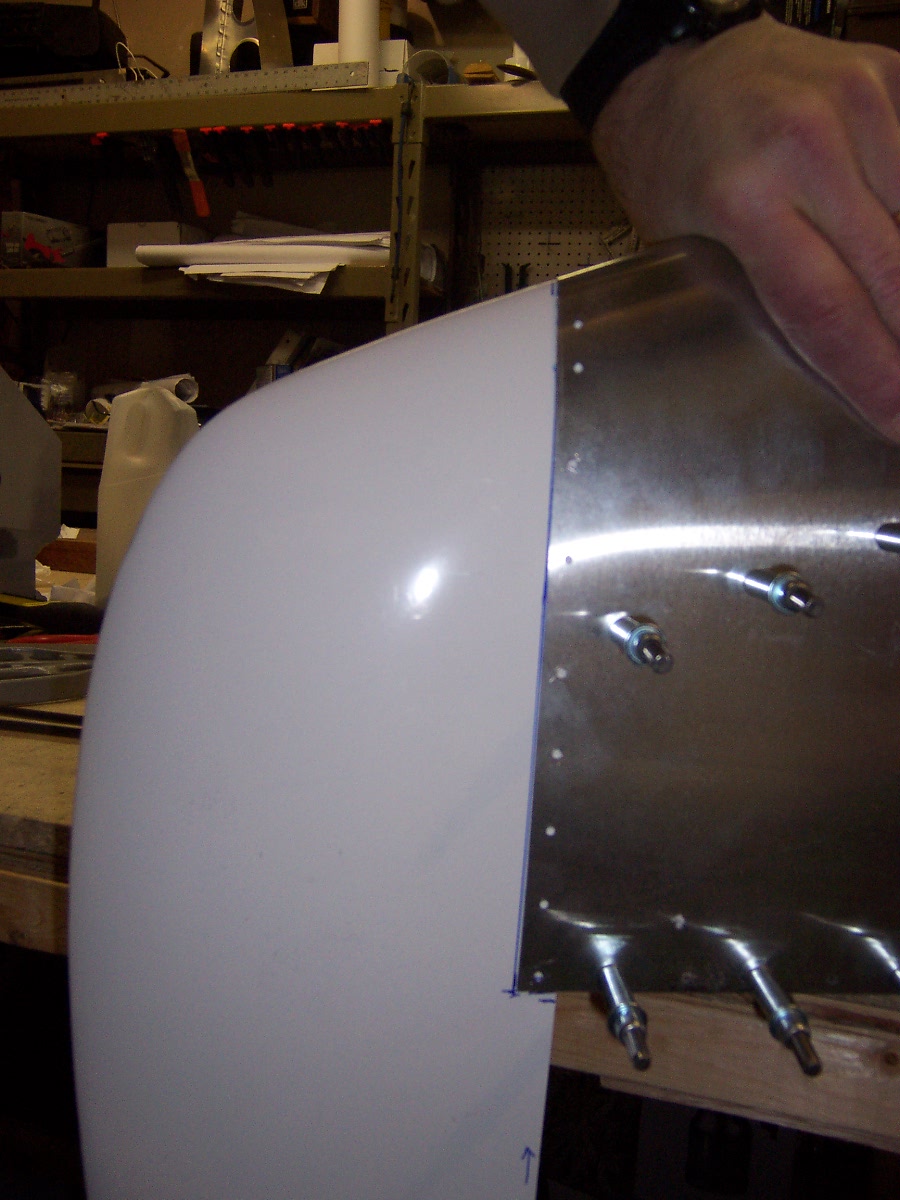


Still toook a lot of fitting and sanding
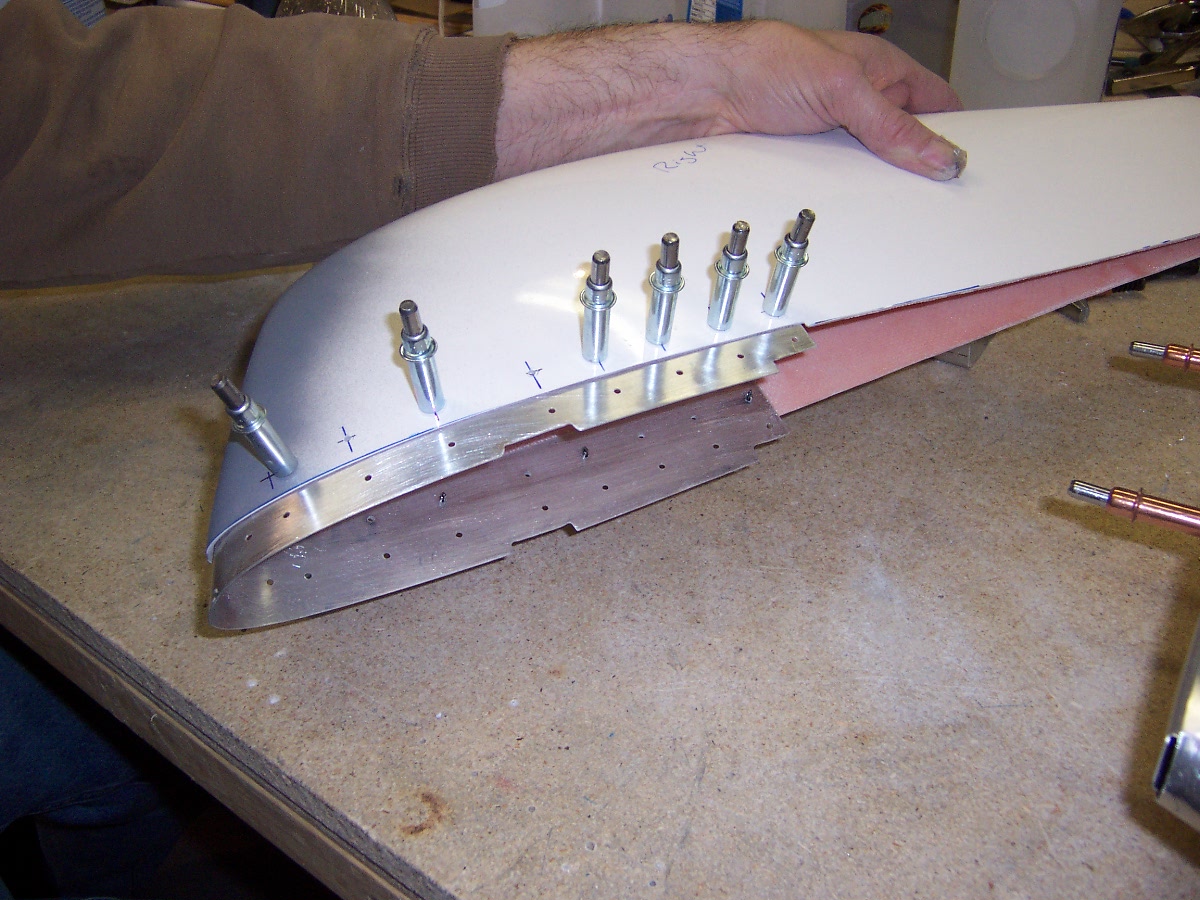

Notice we have a butt joint of the tip and the skin. The plans have the tip slip between the skin and the outboard rib.
The date on thsi if between March and May 2011. We had created a CAD model of the horizonatal stab skin. The plotter has 36″ wide roll of paper and the part is begger than that. So we had to split the drawing and put alignment marks on them to mate them. If you read the Vertical Stab skin drawing entry, you know we were having trouble with the plotter accuracy over a few feet, and also the paper changes dimensions with humidity. We tried out best with the alignment and then wrapped the paper around the frame. With a light we could see where the skin holes were with respect to the center of the ribs. Some were excellent but towards the outboard side it was off a little.

We used spray adhesive (3M 77, let it flash off a while before mating) to adhere the drawing to the sheet metal and snipped it out and filed it to the line. Dan measured and used the yard stick jole template to put the row of holes on each side. We then clecoed the tedges together (using those two rows) and to the table. We bent the leading edge using a piece of wood along the length.
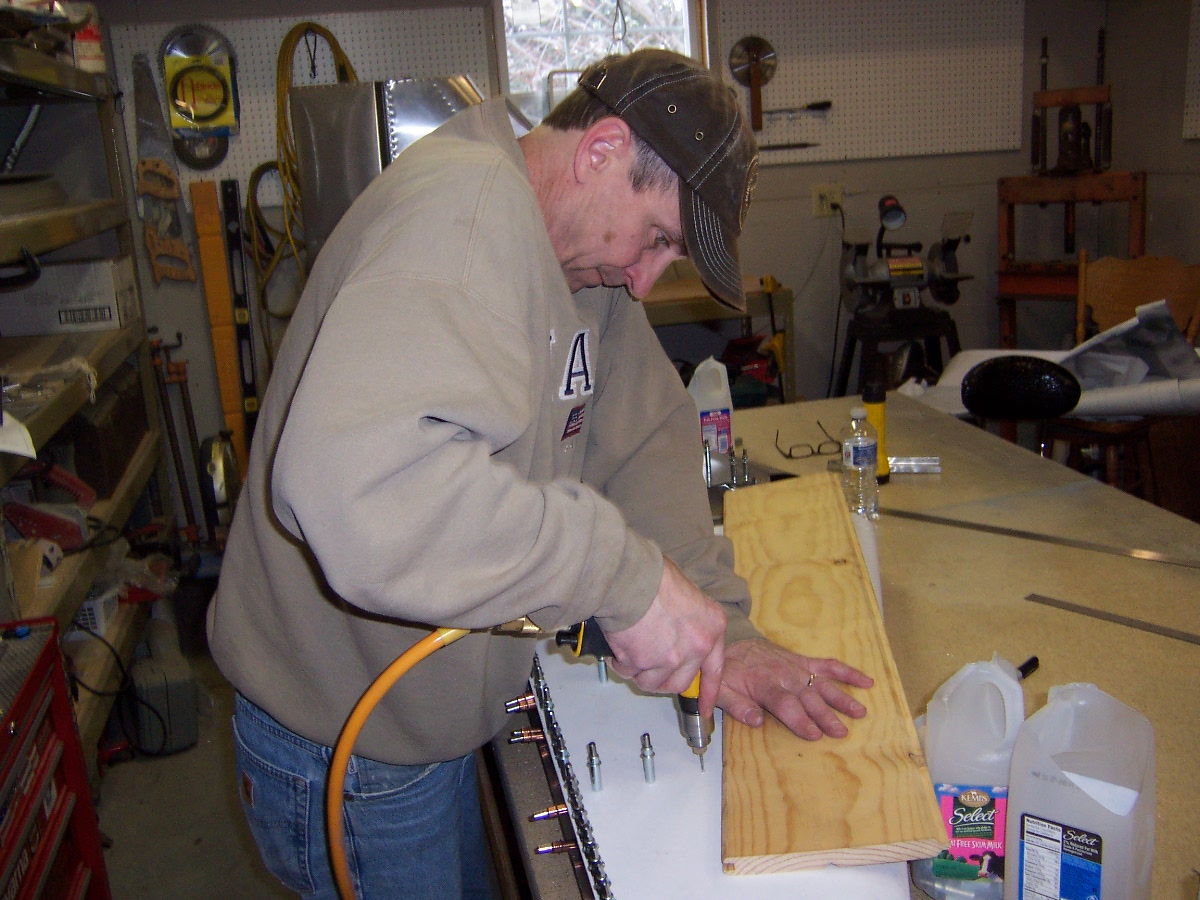
We then clamped one edge of the skin to the frame (took a while to get it right on) and match drilled the frame from the skin. Now the top side we had to match drill the hinge too, so we had 3 pieces we were trying to align perfectly: the skin, the frame, and the hinge. (On a side note we anted to make sure the two seperate hinge pieces were aligned to each other, hmmmm.) Now we could cleco an edge of the skin to the frame and use a pen to mark on the inside of the skin where the ribs are located. In some of the following pictures you might be able to see these lines. Now we could make sure the skin holes would be in the center of the ribs. He did this for the top and the bottom of both skins. Here is Dan drilling out the marked holes

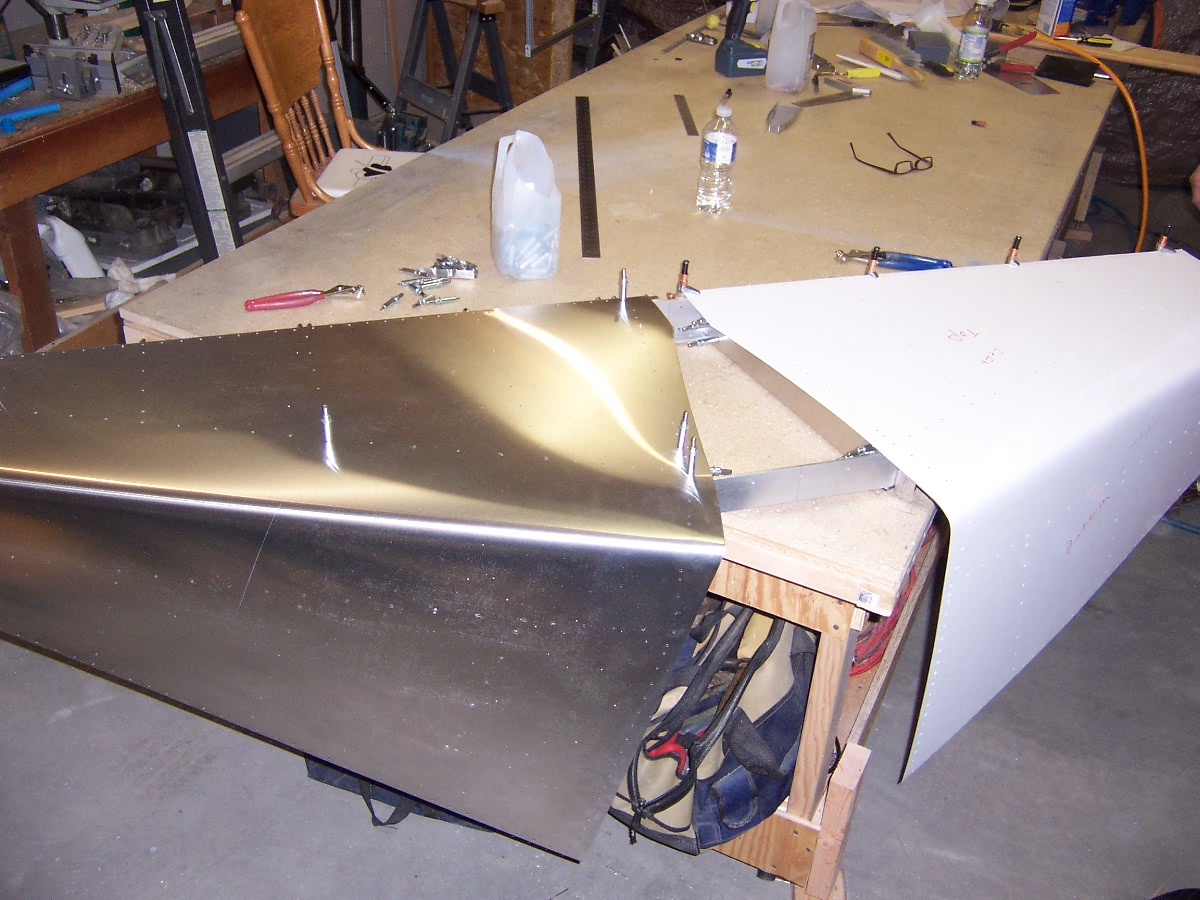



Saturday Jan 8, 2011 (5 hours)
We finished locating and match drilling the spars

We had not attached the T06-06 Clip to the T06-03 Forward Spar Fitting. To locate those horizontally the plans show a dimension from the center of a mounting hole on the Forward Spar Fitting, a tricky measurement to make. We used a centerline mark on the Forward Spar Fitting out to the rib . Vertically we used a centerline and checked with the Leading Edge Rib.
Took me a little while to catch up to how Dan was locating the Leading Edge Ribs (T04-06) to the Forward Spar Assembly (T03-05). We cut a .125 thick piece of aluminum as the spacer to locate the rib away from the spar. Dan had previously marked the vertical centerline of the rib and the centerline of the spar. To align these marks we used a shim between the bottom of the rib and the table (turns out the thickness os a ruler and a piece of .032 was perfect). With the rib aligned we matched drilled it in place.

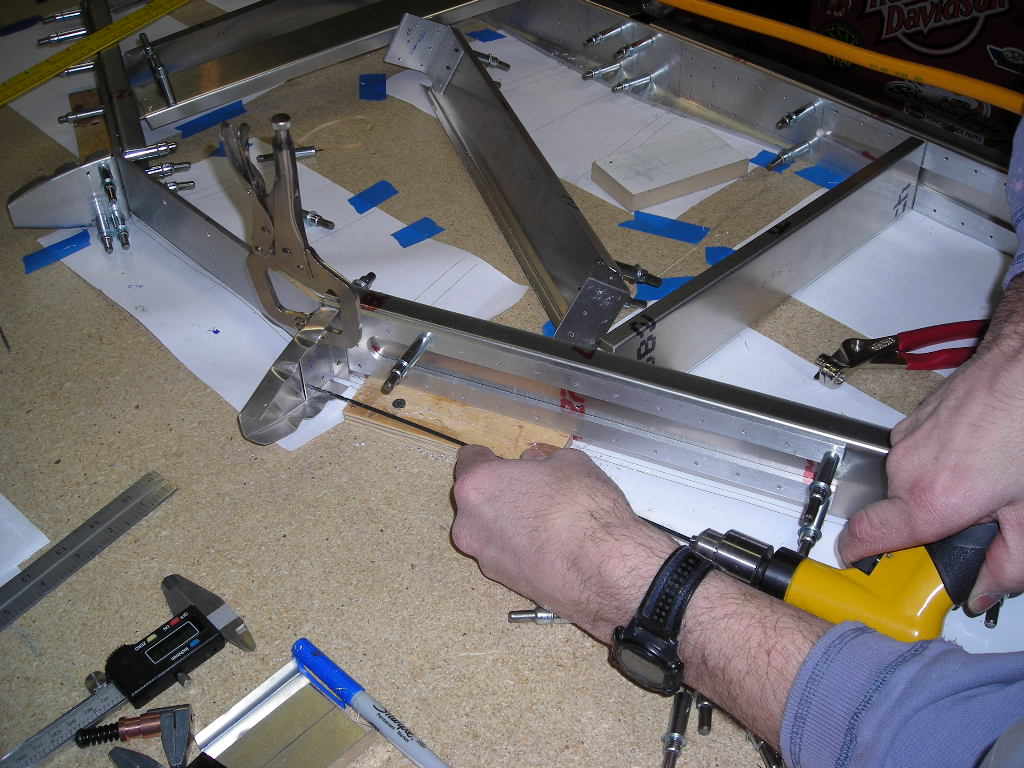

Dan used his paper templates to locate the tip ribs on the frame. The frame is complete!

Once we had the frame match drilled and cleco-ed together we decided to up drill to a #30 right away (just the frame assembly holes, not the skin holes). Sure was nice having one person pull clecos while the other kept drilling. We used a 6″ #30 drill bit in a couple spots, like on the tip ribs which were close to the bench top.
We cut a section of .025 for the rudder skin off a 4’x8′ sheet. The cut was full width (4′) and we scored it. We line up the score cut with the end of the table, place a 4′ straight edge underneath, clamp it down and push down on the other side of the score with a piece of 4′ steel angle. The two us were pushing pretty hard to get the sheet to break (we even flexed the scoring by rotating the sheet up and down). We need to find a better method, especially when we need a piece of .032, so we might try a router next. A variable speed at its slowest rpm might be the trick.
January 2 and 3, 2010
Tim and I worked for a few hours on the afternoon of January second verifying the layout and beginning the match drilling of the stablizer. I worked a few more hours that evening and then finished a large part of the match drilling with #40 drill the following evening in about an hour (I spent almost the same amount of time documenting what I did….something is wrong with this distribution of actual work vs. documenting…..).
From here it’s updrilling, deburring, dimpling, priming and riveting and then riveting. We have to match drill the skin to the frame at some point and at this point we have not completed this step on either the vertical stablizer or this frame so we have to work this process out.
Jan 1, 2011
With the table level to provide a good platform for match drilling of the horizontal stablizer, the layout of the ribs and spars are printed on segments of 8-1/2″ x 14″ paper. Two reasons for this. I don’t have a large plotter and the one we’ve used at work for some tests does not reliably produce CAD plots in the down web direction. We understand this to be somewhat normal behavior for plotters as they wear and/or accumulate debris from use. It may be that good full size plots could be produced but that is a project all in itself and using my home laser printer to generate segments (that are very accurate in their small size) and then laying them out and anchoring to the table seems to be an easy way to achieve the same thing.


