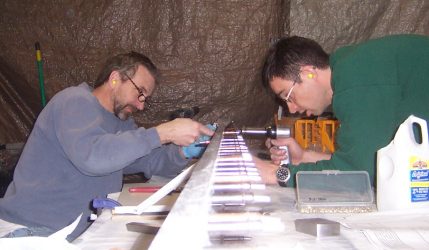
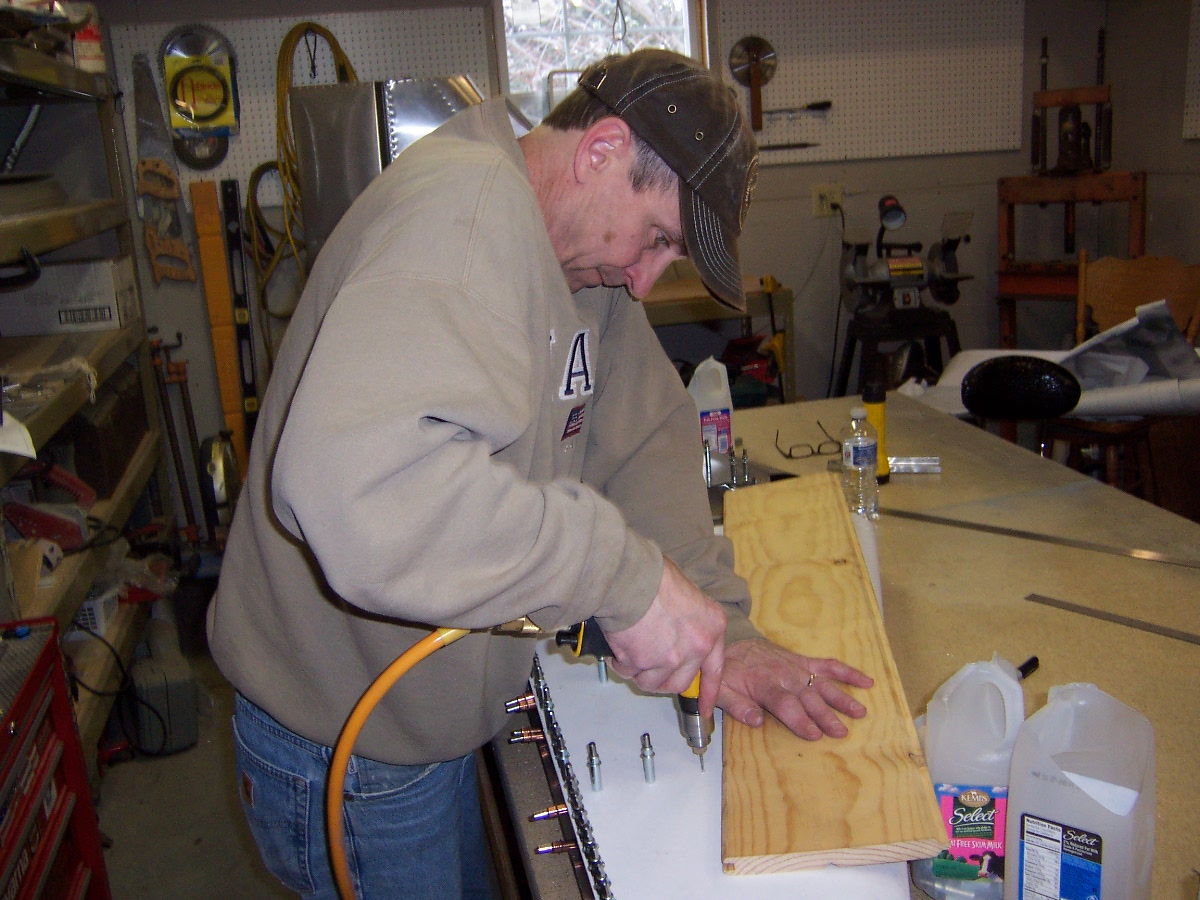
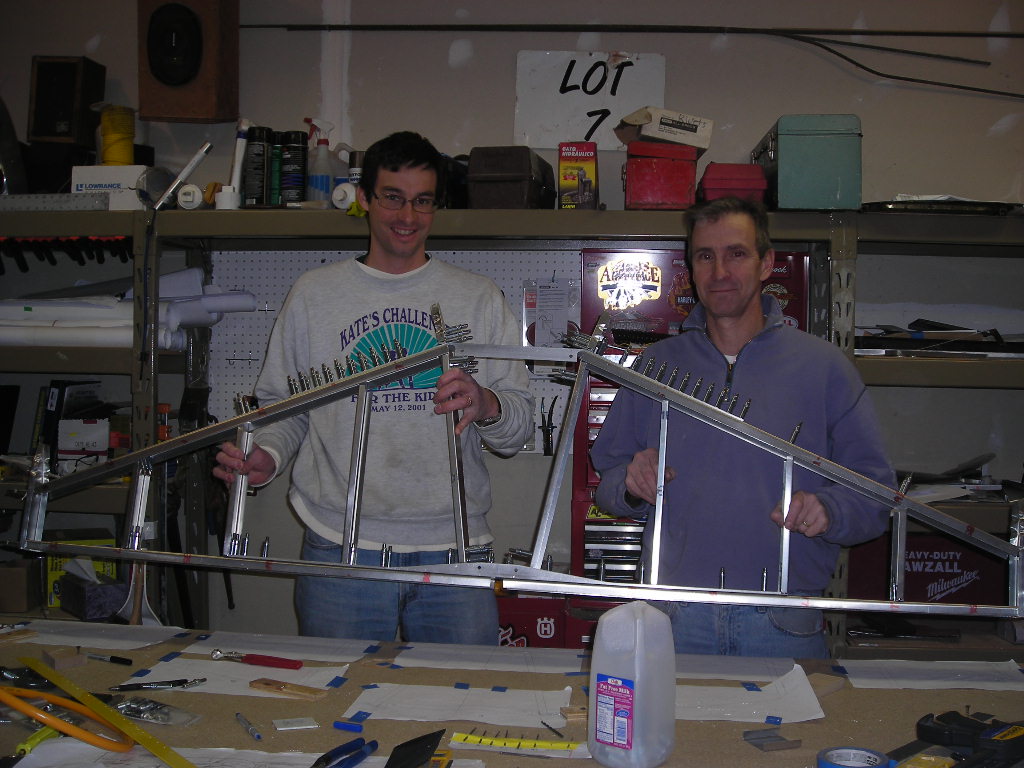
Dan dimpled the hoizintal stab frame and skins and I finished preparing the frame parts for priming.
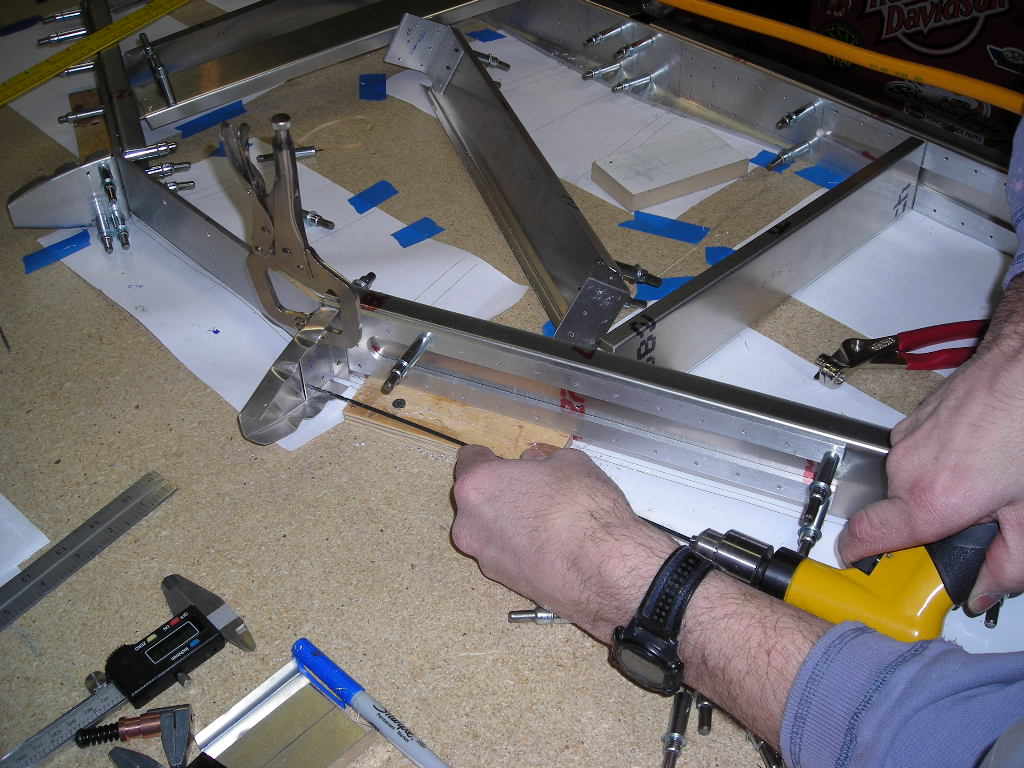
We found a used DRDT-2 dimpler for sale on the Vans Air Force website last fall and used it with a 120 degree pop rivet dimple die from Avery (We also evaluated the Cleveland die and the results are the same.) The DRDT-2 made the dimpling go really fast, but there are a few places that cannot fit (notice just below the die on the bottom beam in the picture).
DRDT-2 Dimpler
Dan had modified a pair of large vice lock pliers. A freind welded on some smal channel to the jaws. The top channel has a hole for the male die half. The lower channel has a 120 degree counter sink hole with a through hole for the male die pin, essentially Dan replicated the female side of the dimple die in the lower channel. We’ll post a picture. It works really well, fits in all the tight corners on flanges.
I prepped the frame parts for priming by roughing them up with 240 grit sandpaper to take the shine off and get some swirls. I would finish up with maroon Scotchbite pad. Lots of surfaces to cover.
June 12, 2011 Dan and I have been struggling with the bottom nose rib on the vertical stabilizer. Dan fabricated a form block that matched the plans exactly. When we installed this rib the skin would not sit right, it had a flat or shallow dish. When I went to rivet it the stems of the pull rivet would break off meaning the ball had pulled up too much. We are using flush rivets so the rivet holes were dimpled. We had to Dremel tool the stainless stem off and drill out the poorly set rivet, a real pain. I think part of the problem is that the natural curvature of the skin does into sit right on the rib, the rib pulls the skin in. Here is a picture of the rib from the plans sitting in the frame with the skin:
Notice the gap between the rib and the skin towards the top.
Dan made some CAD layouts on Autocad increasing the radius at the front of the rib. Dan made a new form block and made the rib. Here is a side by side layout. The primed one on the right is the original design from the plans. The left one is the new rib
Here is the new rib sitting in the frame with the skin. Notice the closer fit.
Fast Forward to Oshkosh 2011. I walked the flight line looking at all the completed Sonex planes and noticed that almost all of them had the awkward skin layout at the top of the bottom rib.
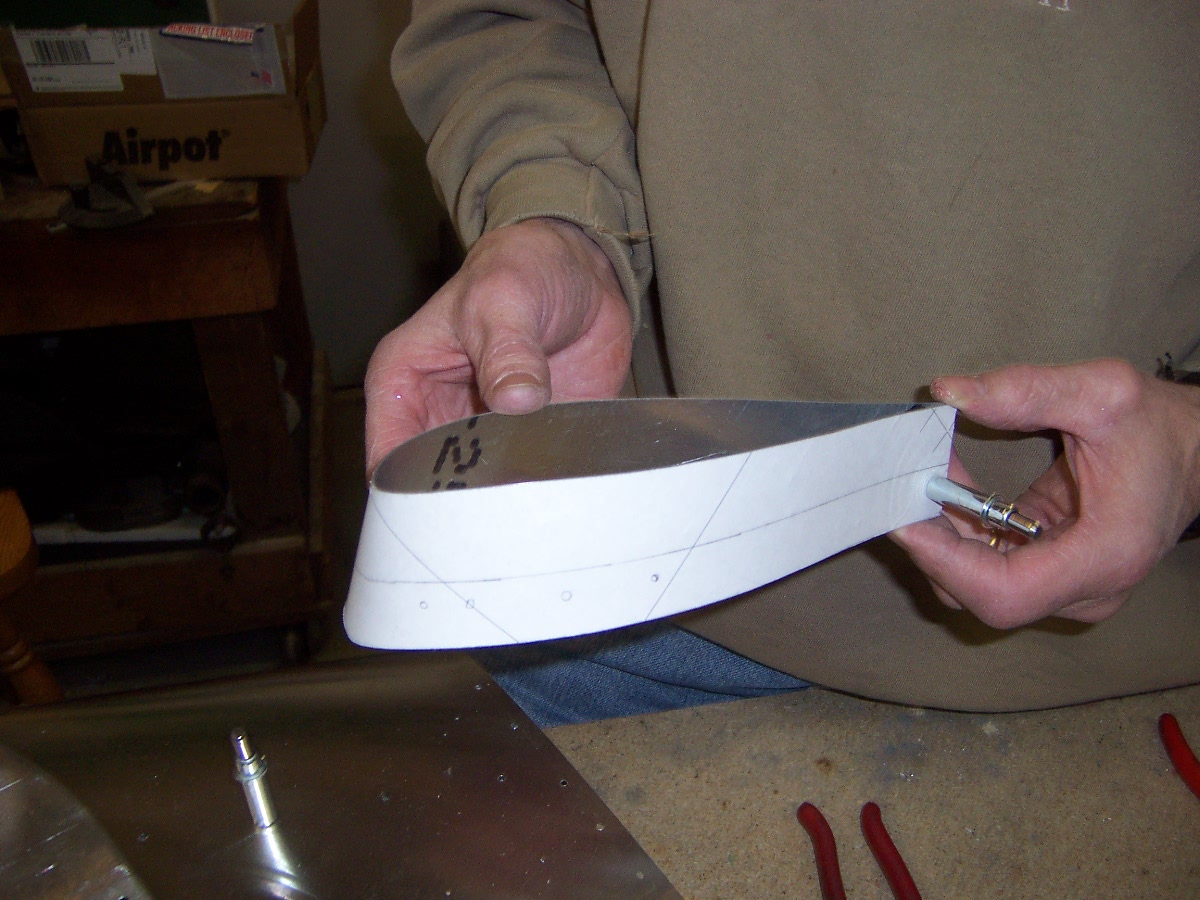
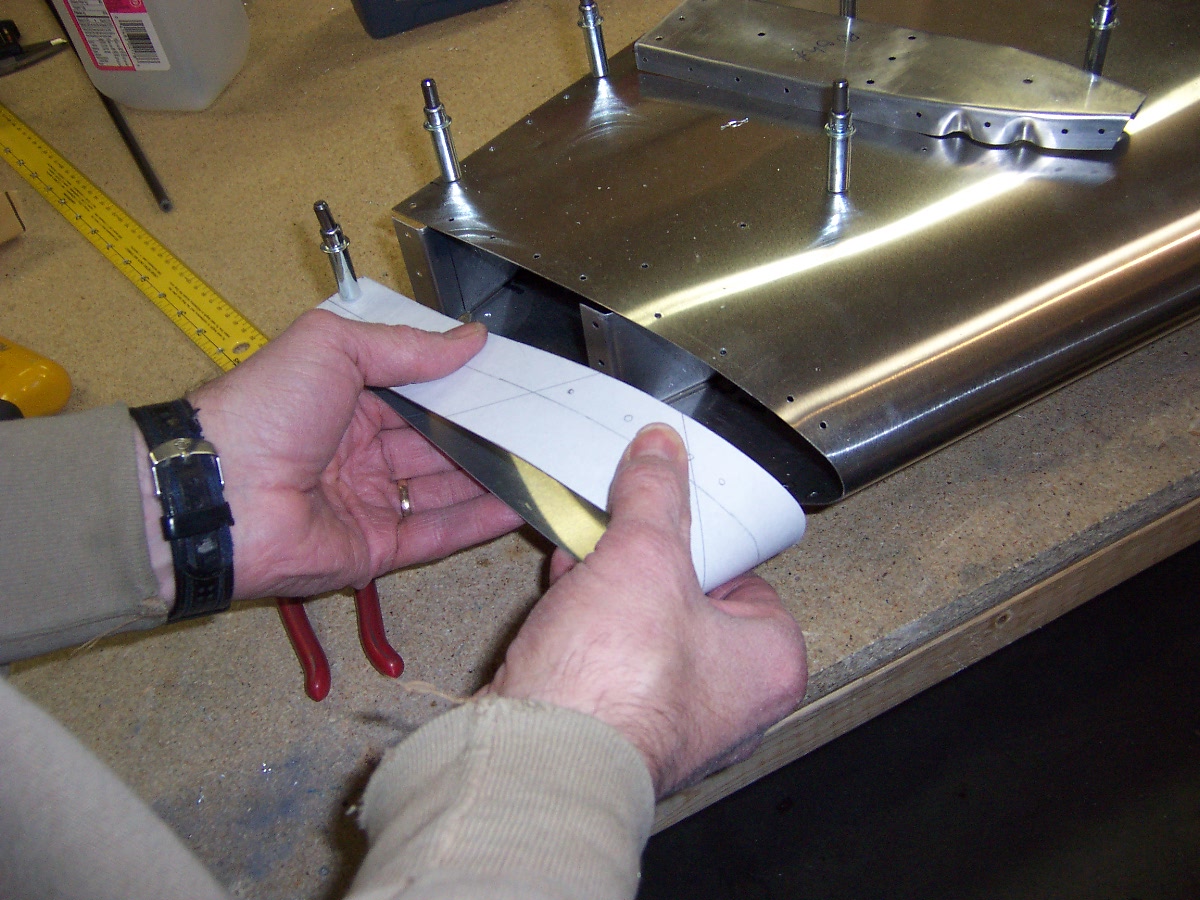
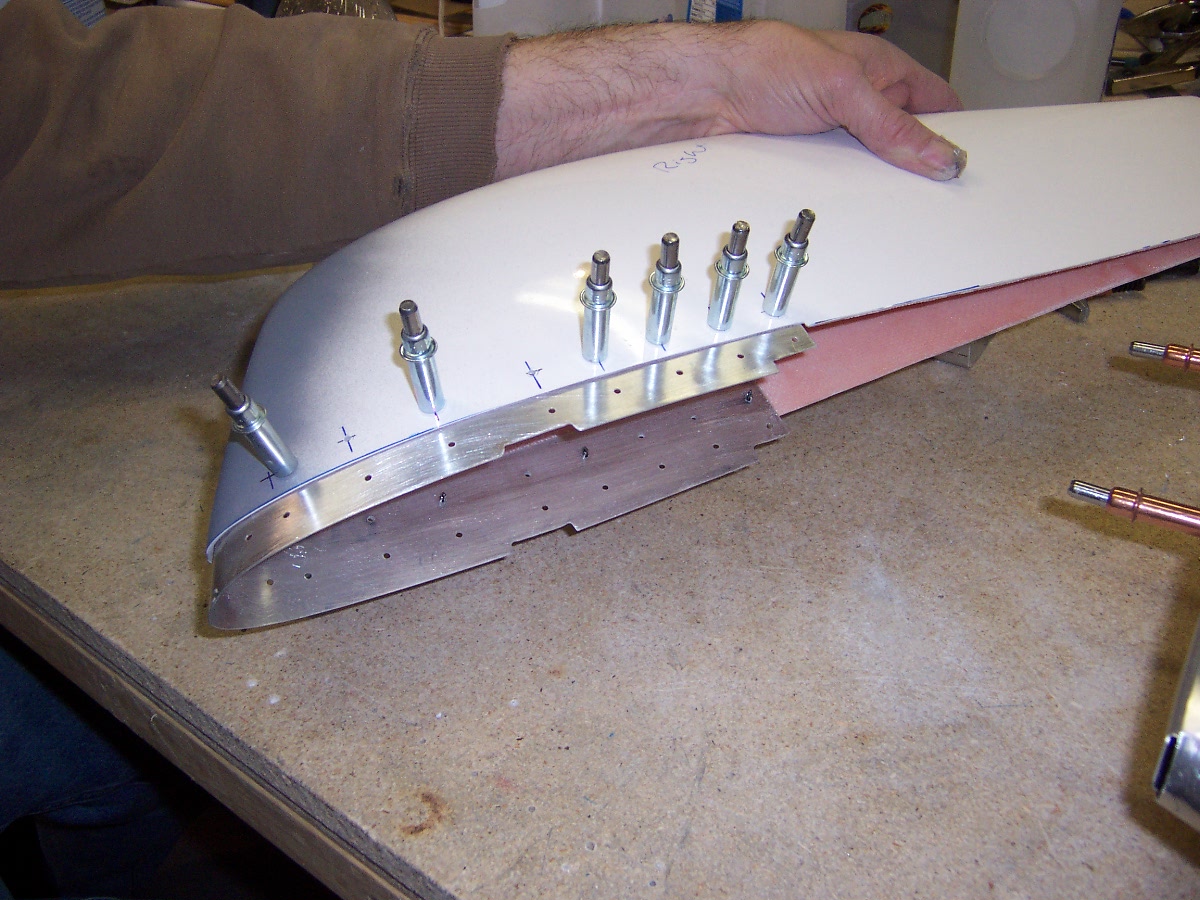
Dan used the same method from the vertical stab tip for the horizontal tips. However we decided to rivet the tips since we don’t think we will need to pull them off. So Dan created a strip of sheetmetal that mounts between the skin and the frame and extends out under the tip.
Horiz Stab Tip Splice Strip
Fitting Tip For Trimming
Measurements For Trim
Trimming With Dremel
Still toook a lot of fitting and sanding
Splice Strip In Tip
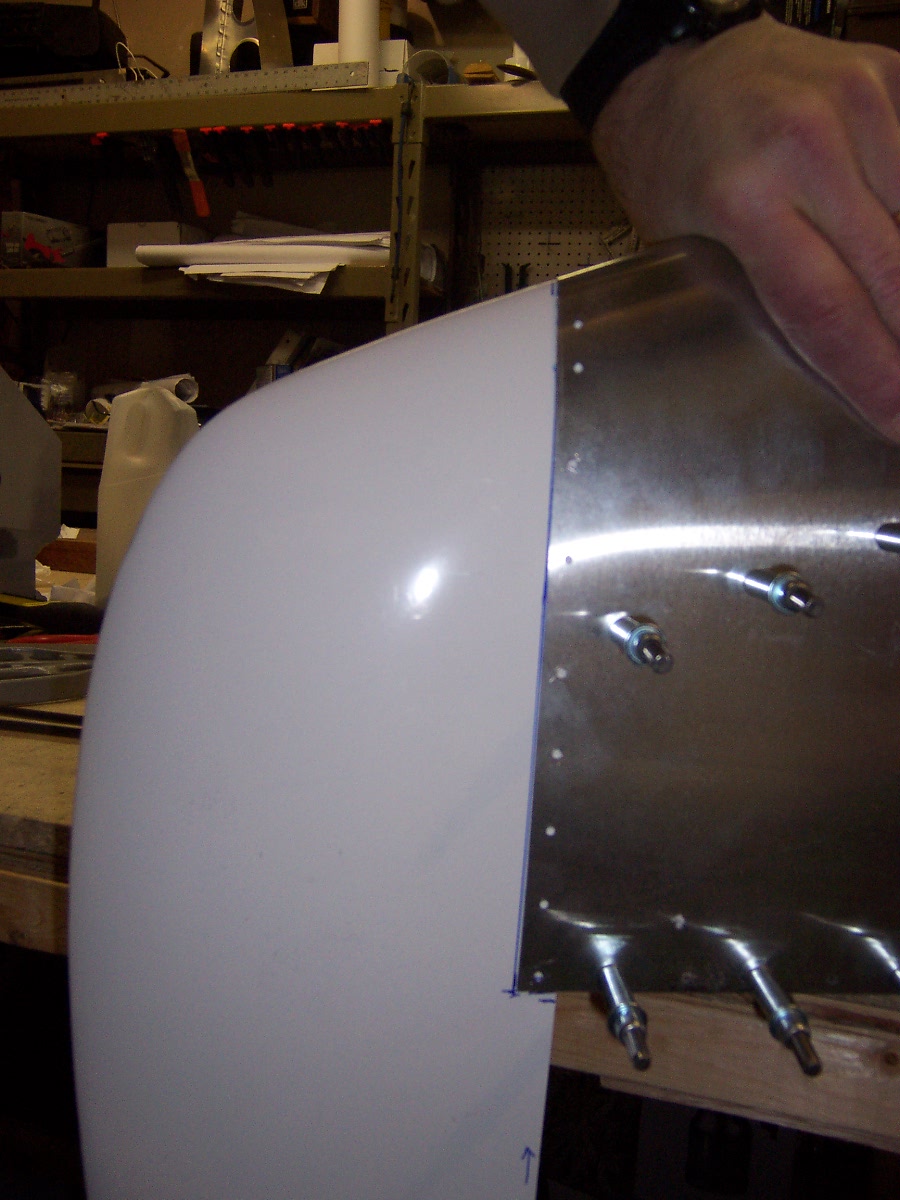
Test Fit Tip
Notice we have a butt joint of the tip and the skin. The plans have the tip slip between the skin and the outboard rib.
The date on thsi if between March and May 2011. We had created a CAD model of the horizonatal stab skin. The plotter has 36″ wide roll of paper and the part is begger than that. So we had to split the drawing and put alignment marks on them to mate them. If you read the Vertical Stab skin drawing entry, you know we were having trouble with the plotter accuracy over a few feet, and also the paper changes dimensions with humidity. We tried out best with the alignment and then wrapped the paper around the frame. With a light we could see where the skin holes were with respect to the center of the ribs. Some were excellent but towards the outboard side it was off a little.
Horizonyal Stab Skin Drawing Wrapped on Frame
We used spray adhesive (3M 77, let it flash off a while before mating) to adhere the drawing to the sheet metal and snipped it out and filed it to the line. Dan measured and used the yard stick jole template to put the row of holes on each side. We then clecoed the tedges together (using those two rows) and to the table. We bent the leading edge using a piece of wood along the length.
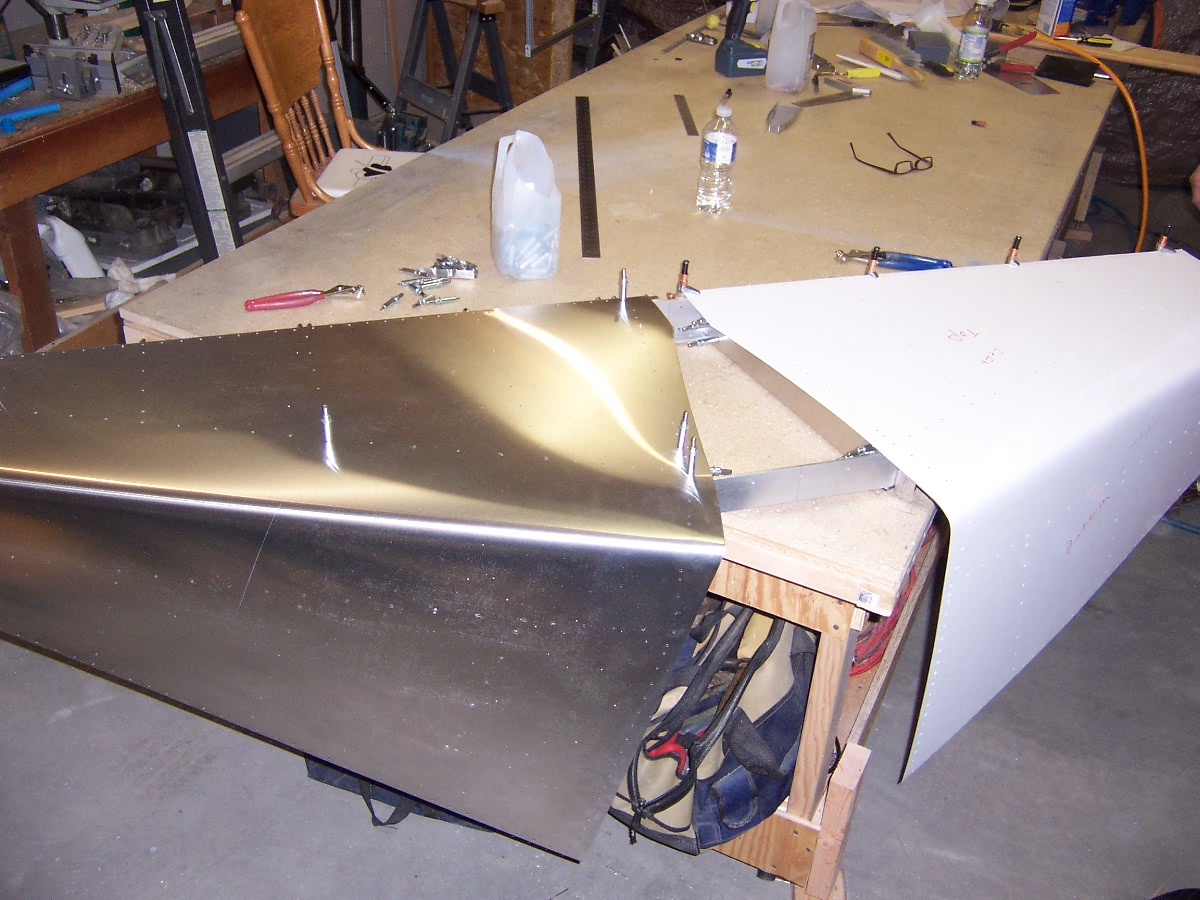
We then clamped one edge of the skin to the frame (took a while to get it right on) and match drilled the frame from the skin. Now the top side we had to match drill the hinge too, so we had 3 pieces we were trying to align perfectly: the skin, the frame, and the hinge. (On a side note we anted to make sure the two seperate hinge pieces were aligned to each other, hmmmm.) Now we could cleco an edge of the skin to the frame and use a pen to mark on the inside of the skin where the ribs are located. In some of the following pictures you might be able to see these lines. Now we could make sure the skin holes would be in the center of the ribs. He did this for the top and the bottom of both skins. Here is Dan drilling out the marked holes
Drilling Horiz Stab Skin Holes
Match Drilling Frame From SkinHorizontal Stab Skins Clecoed On Frame
Not really sure of the specific date of this work, let’s just say it was between Feb and May 2011. Dan I and wanted to have access to the vert stab tip in case we wanted to put a position light or an antenna later on. Dan found some light weight plastic electrical conduit that he heated up to put a bend in to go from the bottom rib to the top rib.
Conduit for Vert Stab
Worsk great, now hoe to make the tip removable. One method uses an upside down rib attached to the top rib so you have a flange to put nut plates on. Dan thought of a different solution of making a sheetmetal strip that goes between the skin and the top rib and it projects up to allow a flange for the tip to attach. I’ll try and find a better picture:
New Vert Stab Attach Strip in Place With Top Rib
The vert stab top rib is on the bottom, the new strip is on the outside and the stip extends up under the fiberglass tip. A great feature of this solution is that it supports the nose of the tip all the way around. Here is the back end of the tip
Here is Dan holding the complete assembly.
New Vert Tip Attach Method Assembled
So the fiberglass tip will butt up against the skin instead of going under it. Dan did a fantastic job of mating these to edges.
Vert Stab Tip Skin Joint (Wicked Nice)
Where the silver clecos are above we will have nutplates behind the stip so washer head screws will secure the tip on.
Here is the horizontal alignment and end alignment with the rudder
With the Stabilizer skin match drilled the next thing to do before priming and final riveting is to fit the fiberglass tip to the tip rib.
Having read a few articles on Sonex web sites related to the problems with this task, I expected (and found) that it was not as simple as just slipping the fiberglass tip to the end of the stabilizer and match drilling it.
First, the overall length, particularly the length of the fiberglass that is left hanging past the trailing edge of the stabilizer, should line up with the rudder trailing edge. While this is purely an aesthetic issue, there is at least one post where the builder installed the tip only to find out after mounting the rudder that the fiberglass tip overhung considerably farther than the rudder. It was not a “look” I wanted to copy. The builder ultimately removed and refit the tip by modifying it. His closing comment was that he spent more time fitting the tip than constructing the vertical stabilizer.
There is a dimension on the plans that shows the trailing edge of the tip should extend 12-5/32″ beyond the edge of the vertical stab. Not surprisingly, this is equal to the rudder tip to the center of the hinge. This reference mark was one that I put on the fiberglass tip to avoid it as I tried to fit it.
Below I show that if I did not put the tip rib in place I could install the fiberglass tip and push it far enough forward to obtain the requisite 12-5/32″ overhang.
The initial fitting of the fiberglass tip would slide under the stabilizer skin without the rib in place and actually fit pretty well with regard to the leading edge of the skin fitting tightly with the fiberglass while at the same time having the tip extend the required 12-5/32″. The fiberglass tip was a bit narrower near the leading edge than the tip rib and therefore would not slide under the skin with the rib clecoed in place.
Tip rib inside fiberglass pushed as far forward as possible. Note the leading edge of the rib corners contact the FG tip and and will slide forward no more. This puts the FG tip about 1/8 – 1/4 too far forward relative to the rib.
I was ready to either cut the fiberglass tip and reshape it to fit the tip or else consider building a narrower tip rib. I mentioned my dilemma to a friend at work who had a hobby / side business of building high performance rods and had experience with fiberglass fitting. He told of a similar story of getting some ground effect fiberglass that fit on one side of the car but not the other and found that he could simple heat the parts with steam and then quickly mount them on the car while still hot and re-mold them to the proper shape.
This, of course, made perfect sense (I had read the issues with fiberglass airframes and the issue with summer heat). So I used a hot air gun with the rib tip as a form pressing from the inside of the fiberglass tip I heated the outside and with a little care I was able to modify the fiberglass so the rib fit inside it and it fit into place between the skin and the rib.
Below is a shot of the inside of the reformed FG tip after heating with the rib pressed forward into the now wider tip.
Rib inside FG tip after heating and remolding the tipCompleted tip installation with rib in place
Top view of fiberglass without any clecos to bring the skin tight to the fiberglass. A little pressure will easily close the gap indicating that when riveted it will be a snug fit.
After heating and molding fiberglass to rib and slipping into place under skin it can be seen that the fit is pretty good even without the aid of clecos or rivets
The end result was that it was relatively easy to heat the FG tip and mold it to accommodate the shape of the tip rib so that it could be slide between the skin and rib and still maintain the trailing edge overhang. I can see that the normal variation in fiberglass dimensions could require more in-depth modifications but using heat to reshape the leading edge of the FG tip was an excellent tool to keep in mind. While the FG tip needed only 1/8 to 13/16″ of manipulation at the leading edge, this small amount created a very large mounting error at the trailing edge. The photos might not show this issue particularly well but the change was dramatic with regard to fitting the FG tip.
Well, after monkeying around for quite some time we finally resolved some issues we were having with plotting the vertical skin out on paper (1:1 scale) and actually glued it (with 3M 77 spray adhesive) to a piece of 0.025 aluminum, cut, filed and drilled it. We used a 1″step drill bitto create the inside corners and tin snips to cut the sheet out. Leaving a bit of material to be filed down to the line with a vixen file on the generally straight edges and a half moon round file on the inside corners was the way to go and made it easy to get right up to the edge of the lines the paer layout provided.
Of course the main advantage in plotting the skin out in paper first is to more easliy mark the numerous drill holes and then (as we had done in the fall) wrap the paper around the frame to verify the pilot holes were something close to the center of the ribs. This along with obtaining a very good layout of the many irregular dimensions as well as getting the layout somewhat symetrical.
The original sheet we plotted and wrapped around the frame was a bit smaller than the design dimensions and so we went through numerous attempts to generate an accurate 1:1 scale plot. As it turns out, the problem we were having was partly due to the inaccuracy of the plotter but there was a much larger issue to deal with. Hygroscopic expansion (and contraction) of the paper.
Hygro-what you say? A large sheet of paper will change by a significant amount in it’s dimensions when moved from high to low humidity environments. What’s more, it will change with a very short time constant. Short as in minutes, not hours or days. We found this by measuring a plot that appeared to be nearly perfect when first generated in an office environment and then after sitting it in a cool garage in a Minnesota winter over night, found that it had shrunk by 3/16″ over a 36″ length. We then moved the sheet back to the warm and relatively humid office environment and watched it regain nearly all of it’s lost dimension over a 20 minute period.
We verified this dimensional change with one of the guys in our research lab that happened to have ran an experiment over the last few years to identify this precise phenomenon. What we were observing agreed very closely with the experimental information that was previously done.
So, we dug out one of the original plots that was pretty close to the correct dimensions when left in the garage overnight and just glued it to the aluminum skin. Once glued to the aluminim the paper was constrained to the dimension of the aluminum.
Before gluing the paper to the skin, we checked the alignment of the rib frame with the paper and found it to be close in overall dimensions but some of the ribs were slightly off from their design locations. We marked which side of the line to drill the pilot holes to accommodate the slight misalignment and then verified these adjustments before drilling the skin.
Backlit paper layout skin over frame to show alignment of drill holes
We had previously drilled out an aluminum ruler to be used for drilling hinges and used this as a guide for edge drilling the trailing edge of the skin first. We verified the location of the holes for the hinge and used the ruler to drill out the trailing edge that would have the hinge attached. We then match drilled the other trailing edge of the skin with the first trailing edge as a pattern.
The gluing of the paper to the aluminum and adjustment of the holes were done on February 7th, 2011 with Tim and I. It was Superbowel Sunday and we both had places to be so we had to stop work. I (Dan) did the remainder of the drilling and skin forming shown below the following night…..
At this point the two trailing edges are clecoed together and the skin can be carefully pressed down on the table with a 2×4 (I used a 1×6 instead) to form the leading edge. With the trailing edges clecoed together it insures that the leading edge is formed in the center of the sheet.
Clecoed and formed skin with 1×6 in background
The above shot shows the trailing edges clecoed together and to the work bench to anchor it while forming. You don’t have to push real hard and want to make sure you don’t kink the leading edge. Just kind of gentle encouragement to
Formed leading edge of vertical skinFormed vertical stabalizer skin when clecoes are released it sits with close to a 90 degree bend
I clamped the sheet to each side and used a sharpie to marke through the skin to the ribs to see how well the holes lined up with the rib centers.
Skin with sharpie dots to identify where holes will be match drilledRed marks show where match drilled holes will land
I examined all the ribs and found that the match drill alignment was as good as I could have hoped on all ribs and on both sides.
There still is some work to do; Clamp and match drill the ribs, dimple the skin and ribs for flush rivets, prime and assemble the frame, rivet the skin to the frame. But to a large degree these steps are “busy work” and don’t carry the concern we had prior to bending the skin.
Even though we have the horizontal stabilizer almost to the same point as well as the rudder and elevator almost ready to rivet together, this will be the first completed frame and skin assembly and it is kind of a mile stone from the fact that it represents (when assembled with the rudder) the completion of many of the procedures for scratch building. There are still many things to do for the first time but having completed this portion is a confidence builder.
We had not attached the T06-06 Clip to the T06-03 Forward Spar Fitting. To locate those horizontally the plans show a dimension from the center of a mounting hole on the Forward Spar Fitting, a tricky measurement to make. We used a centerline mark on the Forward Spar Fitting out to the rib . Vertically we used a centerline and checked with the Leading Edge Rib.
Took me a little while to catch up to how Dan was locating the Leading Edge Ribs (T04-06) to the Forward Spar Assembly (T03-05). We cut a .125 thick piece of aluminum as the spacer to locate the rib away from the spar. Dan had previously marked the vertical centerline of the rib and the centerline of the spar. To align these marks we used a shim between the bottom of the rib and the table (turns out the thickness os a ruler and a piece of .032 was perfect). With the rib aligned we matched drilled it in place.
Checking Position of RibMatch Drilling Ribs, 12″ drill bit since rib so close to the tableRibs in place
Dan used his paper templates to locate the tip ribs on the frame. The frame is complete!
Frame Complete!Nice and Straight!
Once we had the frame match drilled and cleco-ed together we decided to up drill to a #30 right away (just the frame assembly holes, not the skin holes). Sure was nice having one person pull clecos while the other kept drilling. We used a 6″ #30 drill bit in a couple spots, like on the tip ribs which were close to the bench top.
We cut a section of .025 for the rudder skin off a 4’x8′ sheet. The cut was full width (4′) and we scored it. We line up the score cut with the end of the table, place a 4′ straight edge underneath, clamp it down and push down on the other side of the score with a piece of 4′ steel angle. The two us were pushing pretty hard to get the sheet to break (we even flexed the scoring by rotating the sheet up and down). We need to find a better method, especially when we need a piece of .032, so we might try a router next. A variable speed at its slowest rpm might be the trick.