As mentioned, assembly of the rudder was moving along fine until it became apparent that the ruddder was not “square” with the world. My (Dan’s) thought is that this issue is somewhat easy to avoid but just as easy to fall into if you are not careful. The bottom line is that the rudder structure, like the wings, elevators, ailerons and flaps are thin ridgid structures that are expected to be “straight” when assembled. The geometry of the shape suggests that drilling the holes for assembly needs to be done carefully so as not to create a potato chip (warped wing) affect with the final product. A first order analysis of a 3 dimensional box shows how sensative the final shape is to the initial dimensions. If the one leg of a 2-1/2″ x 37″ rectangle is extended by 1/16″ the resulting shape (a rhombus) when coupled to a 3 dimensional assembly will be forced to satisfy the simultaneous relationship of each perspective side. If you attempt to adjust one perspective into a particular orthoganal alignment it will affect one or both of the other associated perspective views. Since the sheet dimensions are fixed (it is unlikely you will distort the sheet in its “x and y” dimensions) the sheet must accommodate the change by shifting in the “Z” dimension. How far will the part move in the Z dimension? A first order guess would be if the long side of a 2″ x 32″ rectangle is adjusted by 1/16″ the far end will raise by the ratio of 32/2 or 16 times the 1/16″ which is a full 1″.
All of this is somewhat accademic but points out what I mentioned to Tim in an E-mail that, while it is important to measure, mark and cut parts as close as possible, it is the assembly process and “rigging” of each part during assembly that defines the “trueness” of the plane. In other words, you can produce precision ribs and spars for the wings, for instance but when the skin is attached to the wing it is very easy to imagine (for me anyway) how the wing could be “warped” and just as easy to imagine how a slightly less than perfect wing structure could be properly rigged when the skin is match drilled to the ribs to obtain a straight wing.
Slight correction of rudder along the hinge which fixed the really ugly rudder
This relatively small adjustment in the match drilling, shown above, was responsible for a rudder that was close to an inch out of “plane” (no pun intended) when sitting on a flat table surface. The cause was the slightly out of square original sheet that was bent into the basic shape and then held in edge alignment through the trimming and assembly process.
The correction was not large and the slight offset in the otherwise very perfect rudder was absorbed when up-drilling to the #30 bit size. A close call and a very valuable lesson.
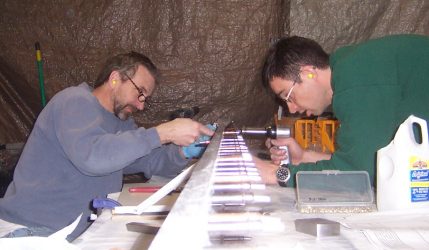
Match drilled rudder to ribs and hinge….found it was slightly skewed from original cutout and bend and never corrected. OK, maybe more than slightly skewed. About 1 inch potato chip shape. No way to fix this easily without making it look like it was in an accident. Can salvage horn without ribs and hinge. Can use the skin for other sheet metal parts (ribs, etc.). If this is like the elevator spar I can make all the parts over again in a fraction of the time it took to do the first time. Maybe one day, 8 hours from beginning to end if all goes well
Bought sacrificial ruler to drill hinges. Studied hinges for rudder to make sure cuts lengths and locations were understood. Trimmed sample rudder to size and marked final rudder skin.
Made T14-03 (optional ribs for fiberglass tips). Assembled rudder horn, assembled elevator root horn. Made elevator trim piece for and attached to elevator horn.
2-1/2 hours .Took a break last night as I was very tired from staying up too late on Sunday night (playing hockey). So tonight I wanted to make sure I spent at least some time in the shop. De-bured the remake rudder horn rib (T13-04 and 05) and bent them to shape. Since this was the second time I made these two parts I paid closer attention to a couple of things. 1) I made sure I had spacer pieces of scrap aluminum at the back end and the sides of the brake to insure the top nose piece was flat when clamped. (I noticed this the last time I bent them that the really small pieces were not held well in the brake so I have been using these small shim pieces on most bends since then). 2) I made sure that I bent the parts in a cirular manner around the perimeter. What I mean by this is that starting on either long side as the first bend, I bent the next side as the shortest sid and finally bent the last side. With each side that was already bent, I made sure it hung off the end of the brake so it did not collide with the nose. The first time I made these parts I bent the middle side last and ended up kind of messing up the first side that was previously bent and had to straighten it out with a hand brake.
The results of this second effort to make these parts was very impressive. Even though the first time I made the parts I thought they turned out really well (I remade them becasue one of the parts was laid out and cut slightly in error and one of the tabs was a bit short and they are such small parts it was easy to remake them). These parts lined up nearly perfectly with the rudder horn.
As can be seen in the photo, we (Tim) drew the part with the bend lines in CAD and plotted it and then we glued it to the sheet aluminum with 3M 77 glue. The part was then cut out and bent following the site lines that were laid out.
Anyway, the rest of the night was spent deburing and bending a couple of the elevator ribs that get mounted to the elevator horn and finally bending two of the six straight ribs for the horizontal stabilizer (T04-01).
OK, we’ve put off bending the control surface for the vertical stabalizer (AKA the “rudder”) for some time. All the control serfaces, (rudder, elevators, ailerons, flaps) are very similar. The elevators and rudder (shape Z03-01) are the same cross section with different length wise dimensions and the ailerons and flaps (Z02-01 and Z02-02 respectively) are each made of unique cross sections but in general are not too dissimilar from the rudder shap.
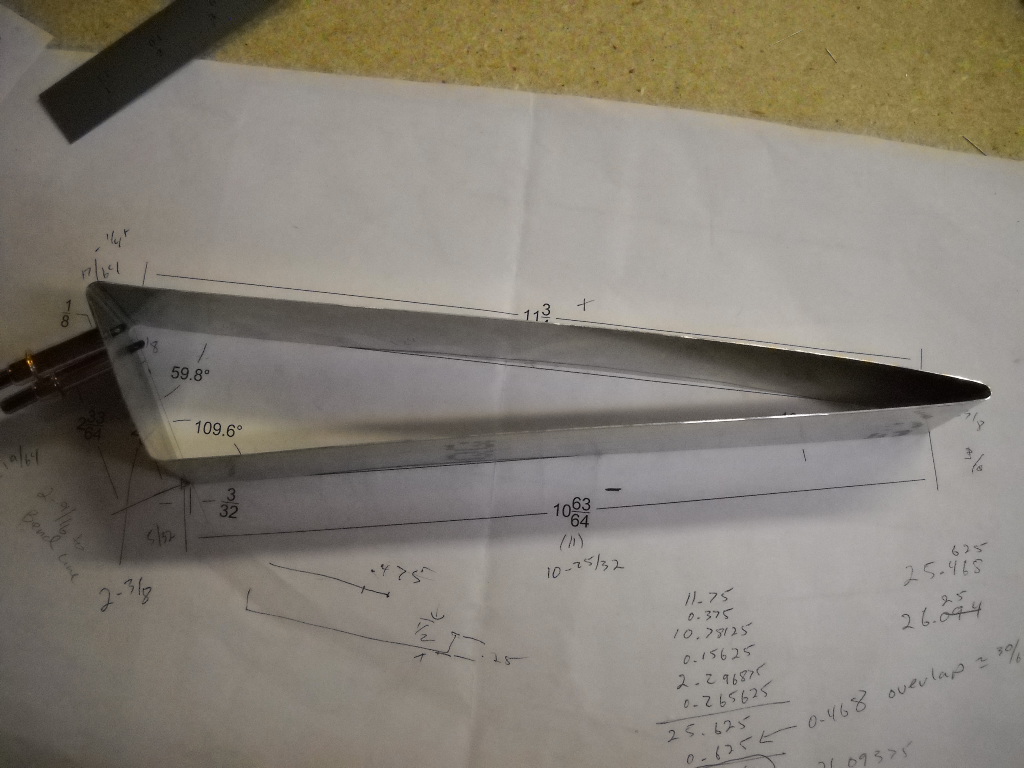
The one thing we did prior to this was to take a scrap piece of 0.025 and try to mark it out and bend it to match the drawing dimensions. I had also made a full size plot from AutoCad of the cross section of the rudder to help identify the “sight lines” for each bend. Tim ultimately used his mechanical engineering expertise and provided a bend diagram that I used to mark the flat part.
Sample Z03-01 bend
So, Tim came over last week and we cut out a 26″ long section of 0.025 for the rudder and I’ve been looking at it all week trying to get psyched up to take a shot at bending the thing. This morning I looked at the things I could do and thought it was time.
First, I cut the final rough dimension from the 48″ wide piece of 0.025. According to the T13-01 dimensions this should be 42-63/64″ to the longest projected point. At the Sonex workshop they mention the highly precise dimensions on the plans and allude to the difficulty of cutting parts the this level of precision.
Just to save anyone reading this the trouble of digging out a calculator, 1/64″ is close to 16 mils (1 mil = 0.001″ so of course 16 mils is 0.016″). This is about the width of the line that the “ultra fine” Sharpie pens will make. Cutting sheet metal to this level of precision consistently is nearly impossible with hand tools without spending an inordinate amount of time doing it. Besides, the rudder will be cut again for final length with an angle after it’s bent to the basic shape so in my book, 42″ (+/- 1/32″) for an overall length is close enough.
As an editorial comment, I’ve tried like heck to be as accurate as I can with every part I make and have found that the angle aluminum parts can be filed to within 5 mils pretty easily but in most cases it does not pay to get the part any more precise than maybe 10 mils and that might be excessive for most parts. I say this with regard to small dimensions (less than 6″) becasue I only have a 6″ micrometer) You can try to mark and cut large pieces to a higher level of precision but without a large micrometer you are relying on your ability to see and mark off a ruler with a marker lays down a paint stripe that’s 16 mils wide.
Anyway, my 50+ year old eyes cannot mark much better than 1/64″ using a ruler or a micrometer if anyone wanted to check my work I’d not be surprised that I’m not within 1/32″ with most things I bend or cut.
Enough of that, what about the part……
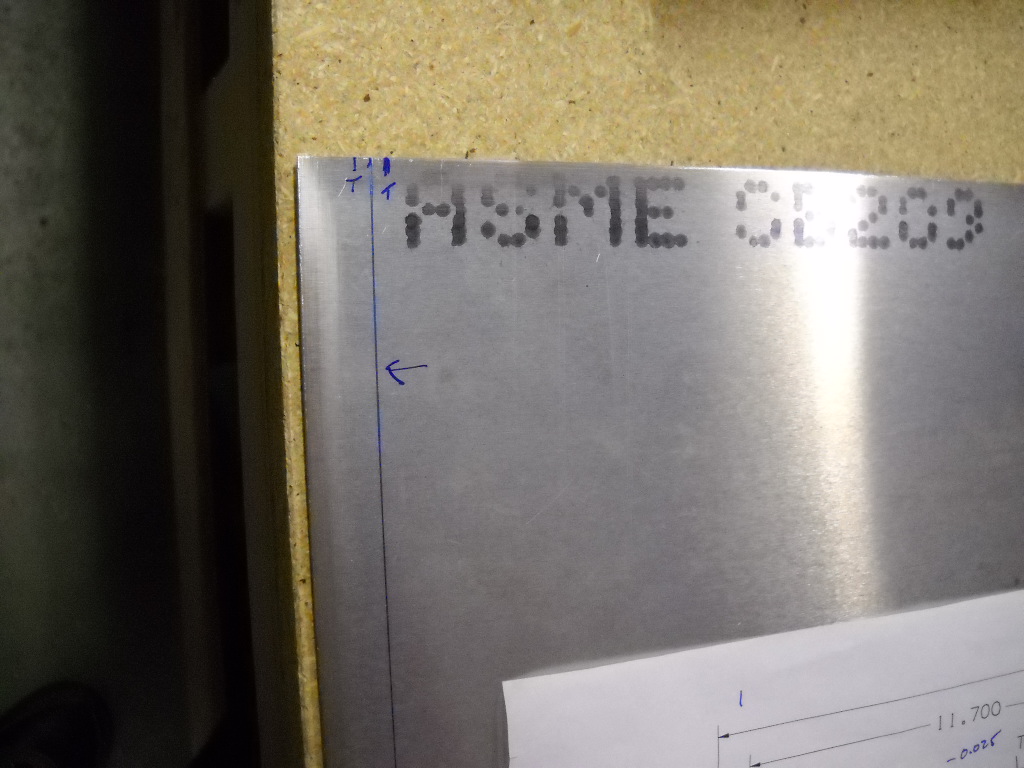
After cutting the sheet to the overall dimensions needed for the rudder control surface, which is 42″ x 26″ I cleaned up the edges with a file and then scotch brite .
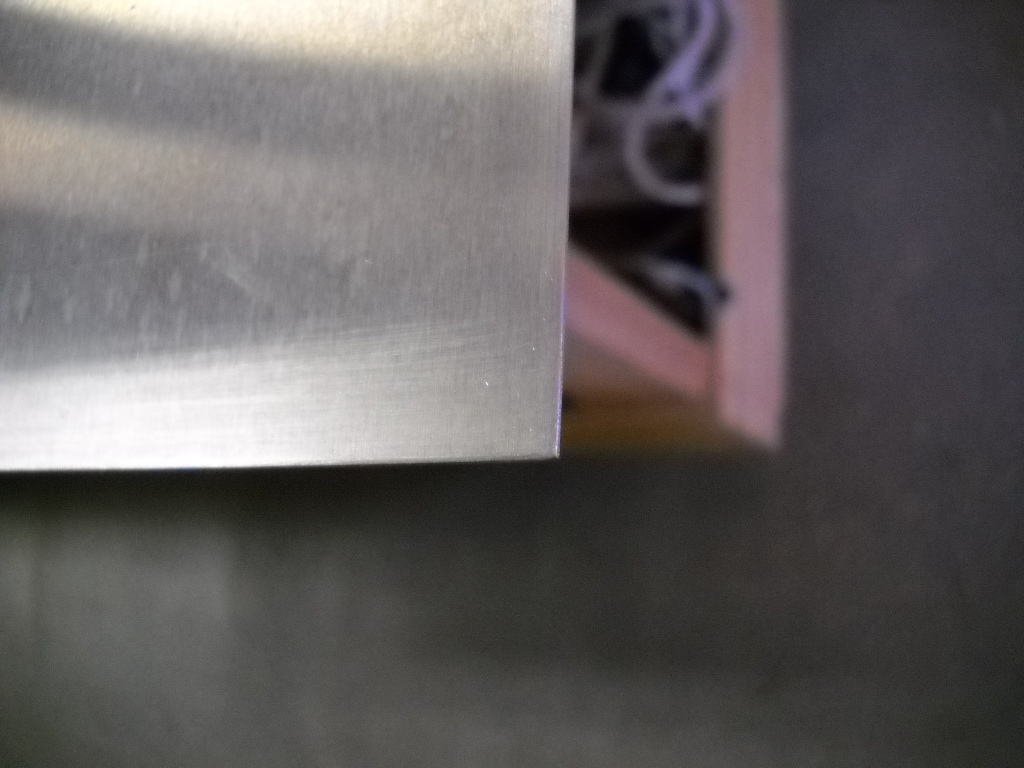
42″ x 26″ sheet after cutting to size and deburring
A close up of the deburred edge.
So one of the things that becomes apparent to anyone that has bent parts and something they teach in mechanical engineering school (and probably drafting technical schools as well) is a little of the science of sheet metal bending. Where as machined parts can be cut to a particular length and then two parts can be butted together and fastened with bolts with the resulting part adding up with the associated tolerances of the parts. The problem with bending sheet metal is there is a radius that is typically prescribed for a bend. Each bend has a couple of components that are important to identify when marking and bending parts.
Below is a sketch of a cross section of a “nose” on a brake and the noteworthy dimensions that are useful when bending a sheetmetal part:
This diagram shows a theoetical bend and defines the resulting dimensions for a 90 degree bend. It is important to realize that these numbers are valid when clamping as shown in the diagram. When clamping from the other end of the sheet metal, in the drawing it would be the short end, a symetrical relationship exists and what is important is that the sight line, which is what you need when placing the sheet metal in a brake, moves by 0.43 times the bend radius (assuming your final bend radius is what you planned on).
The thing to remember in the case of the more complex parts like the control surfaces is that the bends are often (or in the case of the rudder, always) not 90 degrees.
Tim generated a diagram of the complete sheet along with distances from the edge to each sight line. This diagram turned out to be a very good guide for bending the rudder and elevators.