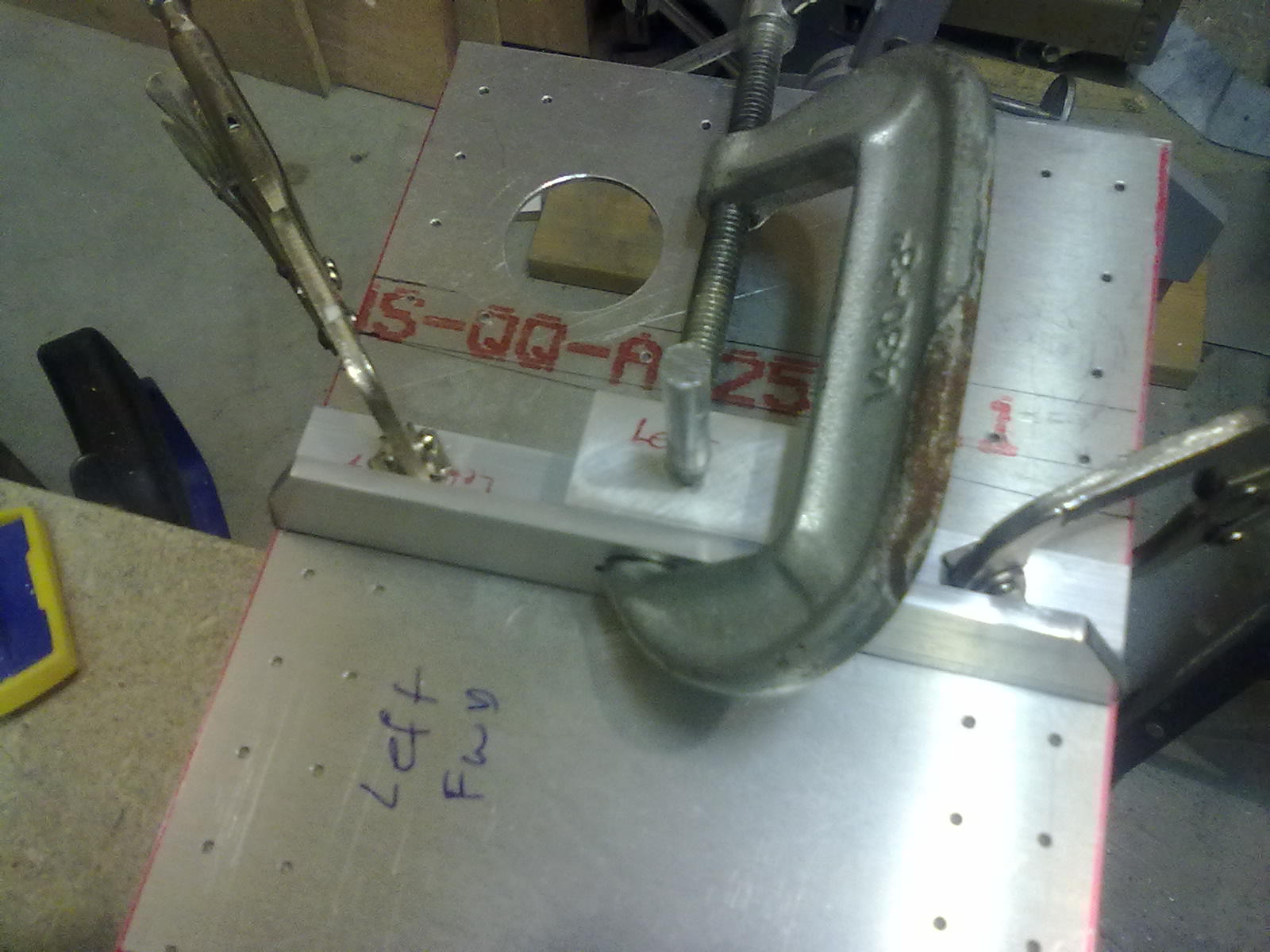
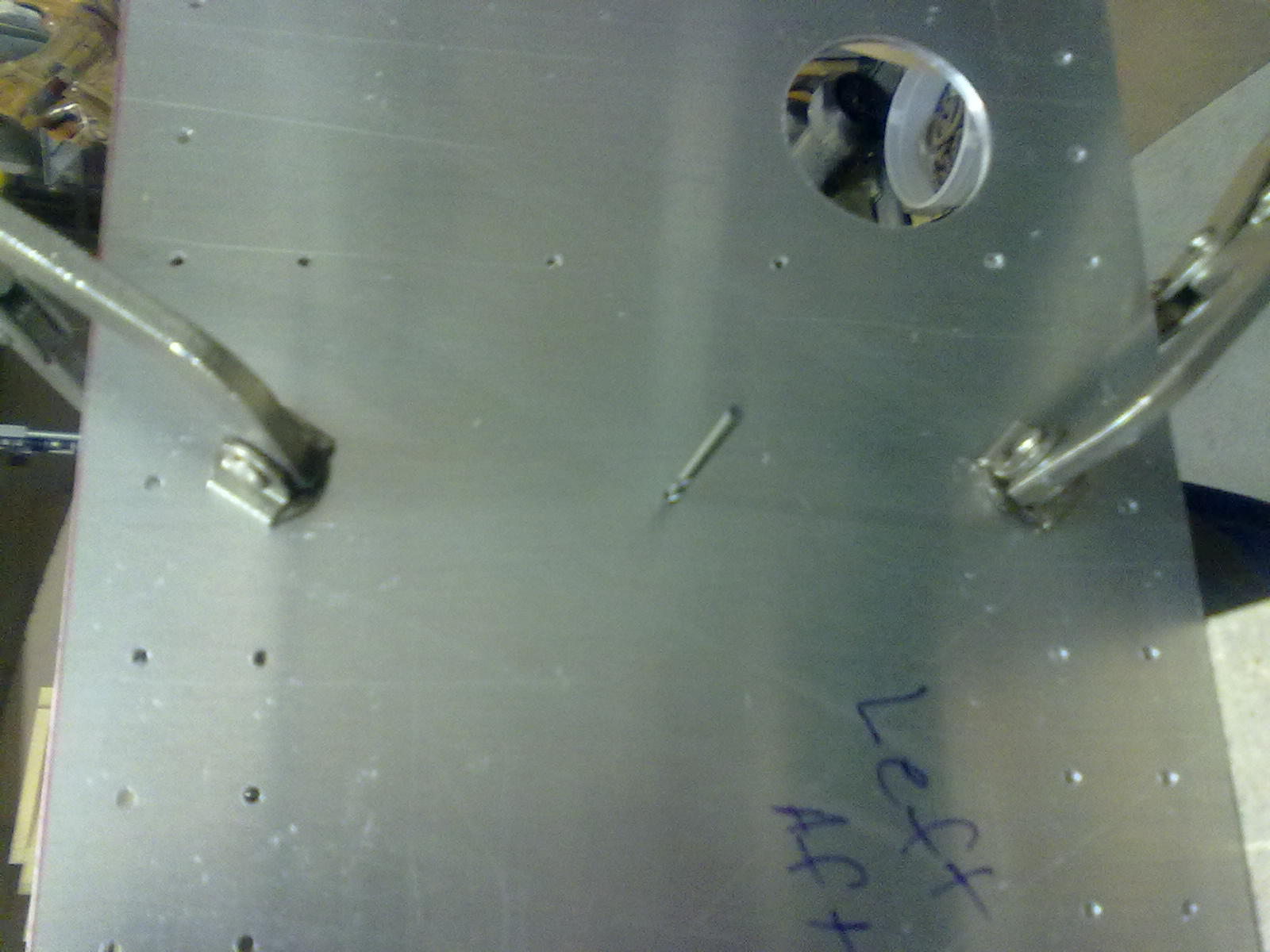
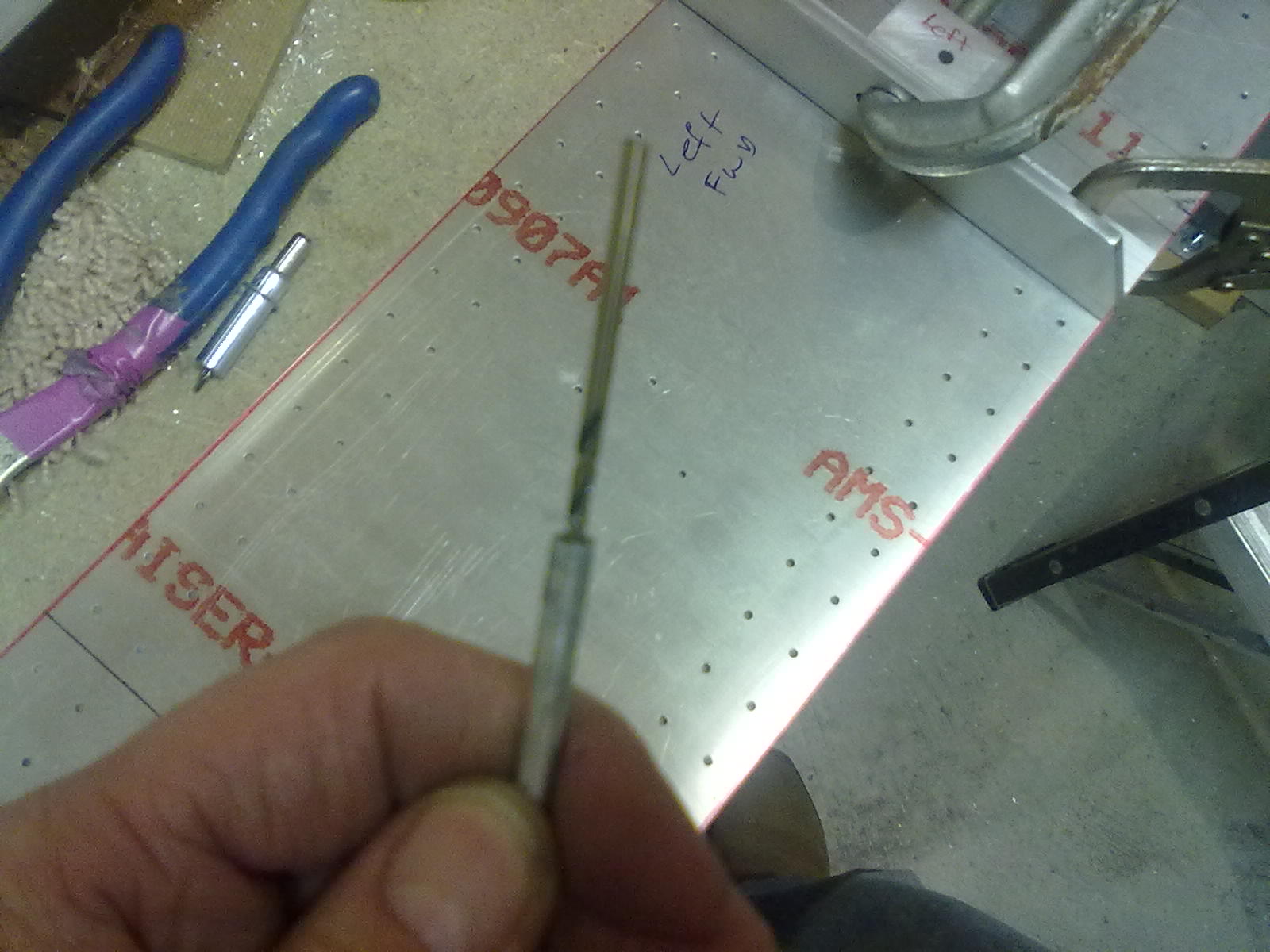
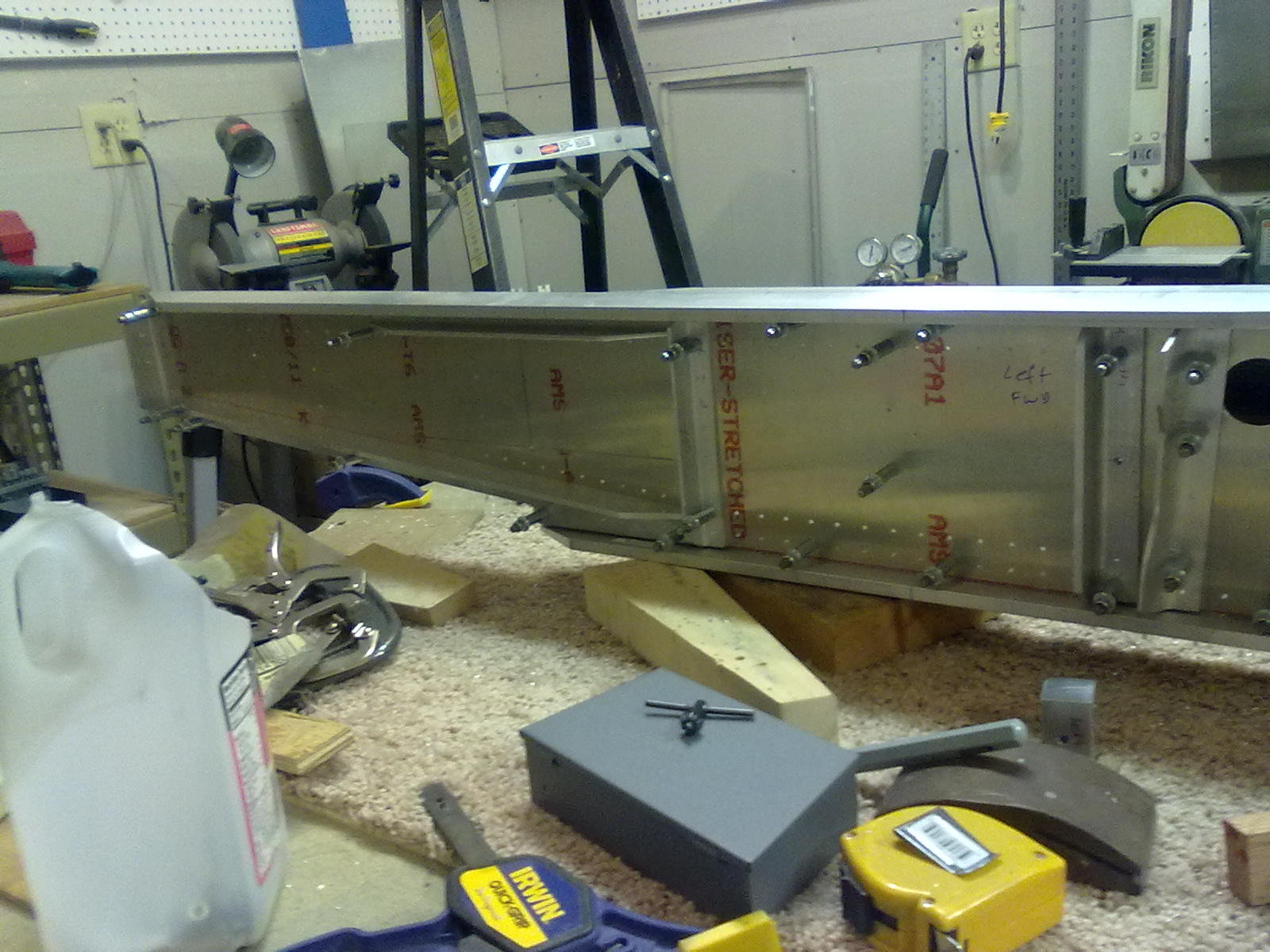
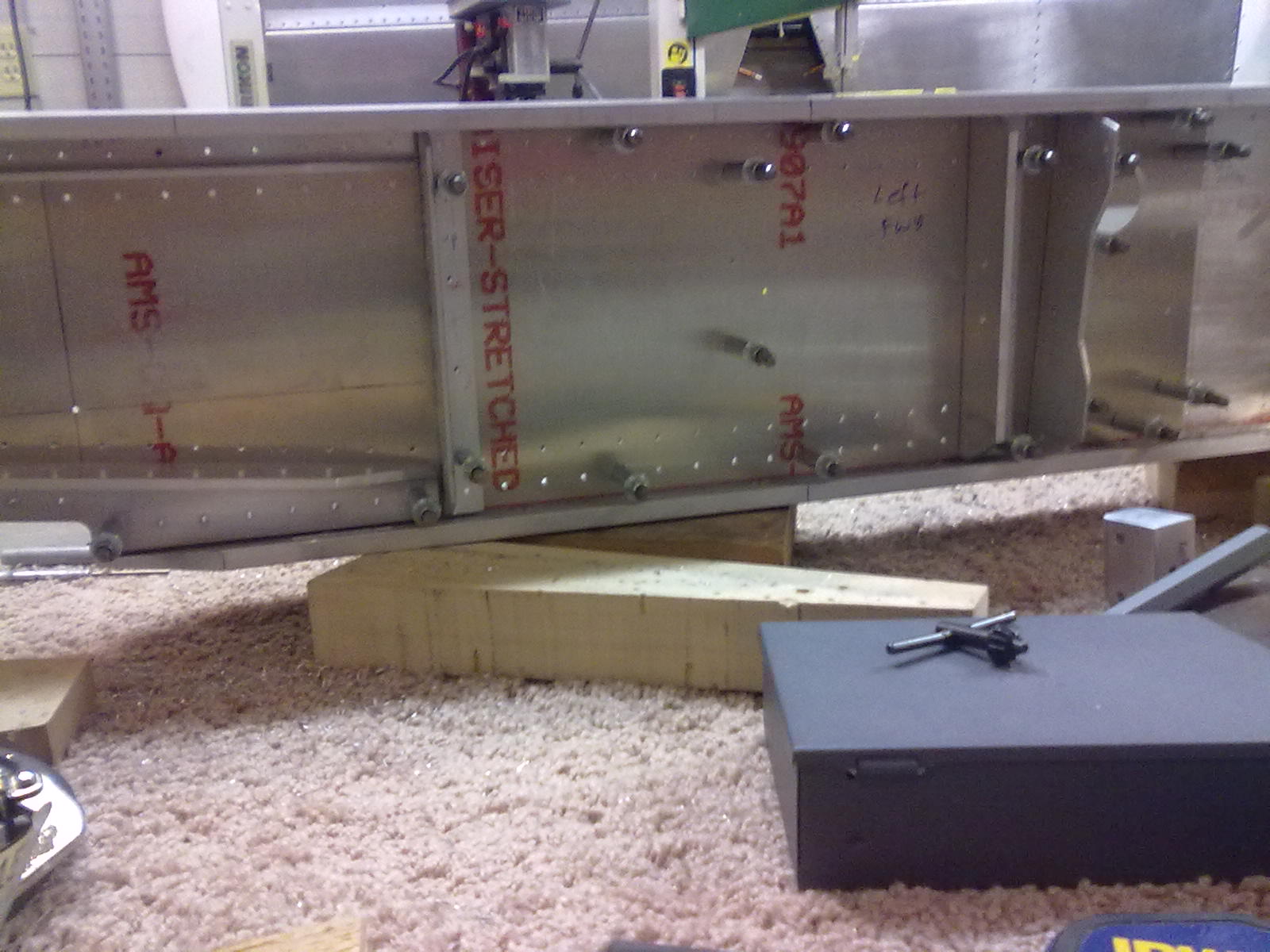
Dan and I were looking over the rivets and Dan spotted a couple that were just OK. One in particular had a little angle on it, so after a short discussion we decided to give it a couple hits from the rivet gun and bucking bar to flatten it out. As you are probably thinking, we should have left it alone. The bucking bar tilted in my hands and the shop head looked horrible, we were so annoyed. One more to drill out. This row is the -12 lengths which is the longest and you really don’t want to enlarge the hole. Dan drilled it out really well, I’ll have to call him the surgeon. Here is a couple pictures of the new rivet before and after. Notice we put tape on the angles around the bucking bar to prevent scratches.
Test Assemble Spars Halves
Dan put the spar halves together with clecos and the five assembly holes mated really well. (We use wing nut clecos here because you can really draw them up tight.)
Looking Good
Finish Riveting Left Hand Spar
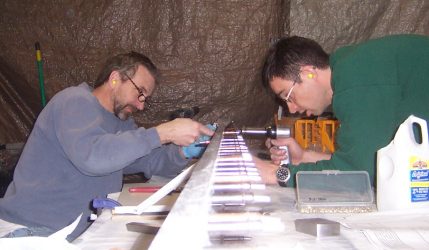
Dan & I worked on the inboard rivets. In this area the spar caps are the widest so one needs to pay more attention to the rivet gun and bucking bar. This is also where the flush rivets are. In addition there are angles on the spar web that make it thicker. This means longer rivets and for some reason they are harder to set perfectly, especially the long flush ones. Here is our progress for the day:
Dan is really good using the rivet gun with the flush set. But I had “issues” with the bucking bar on these rivets in the top row of the picture. (by the way the spar is mounted upside down).
The plans call out for -12 lengths but our rivet gauge shows they were a tad too long. We had trouble on the Right Spar in this spot but we thought we had more experience now so we tried it. The first was OK but the second and third collapsed to one side, its like they form the head offset from the main stem. These were a pain to drill out due to their length. We decided to heed the rivet gauge and sand down the rivets a 1/16 or so so they fit the gauge. I still had trouble and a few collapsed off-center. What a pain. Dan was not having fun drilling these out. It was a long frustrating session. I was probably tilting the bucking bar as it collapsed but the process happens so fast I am not sure what happens. In the photo below you can see a row of holes that you need a special bucking bar to access due to distance between the angle and the spar cap (see this post):
Our tool from the Right Hand Spar did not fit, so after I left, Dan ground a new bolt to fit there. Dan talked his wife into bucking those really hard to reach rivets. Thank You Thank You. Those are hard to do since you cannot see the rivet so its hard to tell of you are the right angle. They got them all done, awesome.
Priming Assembly Start Riveting Left Hand Spar
During the week Dan finished up the spar cap preparation. Dan mixed up some Har-Hyde self etching primer and sprayed the left spar parts. I arrived just as they were finished drying, what great timing. Dan put a really nice thin coat on, notice how you can still read the red printing on the parts.
We assembled the left spar by first putting in the AN bolts and screws. Due to our “bolt-fit-obsession” you cannot cleco the parts first and expect the multiple bolts to go through all the layers in the assembly.

Added some black clecos and ready to rivet.
We borrowed a 3X rivet gun from a friend who is building a Rocket. Our EAA Tech Counselor suggest to start in the middle and work out to both sides.
We got about 5 rib bay sections done when I had to leave. Dan was able to finish most of the dome head rivets to the tip. Here are some of the rivets:
RH Spar Riveting
Here are some pictures of riveting the right hand spar. The first picture is using a tungsten bucking bar we borrowed from a friend. It weighs a lot since the density is so awesome.
This next photo shows a really difficult area to buck the rivets. Not even the little tungsten bar would fit between the angles. We fabricated this bucking bar from a piece of round stock and a bolt. Notice we had to machine one side of the bolt, we also rounded the edge so it would fit in the radius of the spar angle. These rivets are pretty long so they take a little more from the gun to set. (We had a fun discussion about the physics of why they took more to set than the others.)
Below is the completed row, they came out pretty well. I would like to know how people rivet this row when they use the Sonex hammer and bolt head process. I imagine they back rivet and machine a bolt like we did.
In the next picture the rivets are on the top row were -12’s and were a hair too long by the rivet gage. We borrowed this gauge from a friend and it is really nice to check the rivet length before and the shop head diameter and height once set.
Well we tried the -12 and a couple were OK but then they started to dump, or mush to one side. We think I was tilting the bucking bar up a little and the long rivet would mush over from that misalignment. We drilled those out, which is a pain since they are so long. We shortened the rivets to match the gage length. We used a belt sander but they got hot quickly. I didn’t want to over heat them in case that would change their properties. I’ve heard about rivet cutters, but pretty expensive for a handful of rivets. In the end we got them all done.
Countersinking Spar
Dan spent a lot of time figuring out the proper countersink depth to allow the dimple to properly form over it. See this post Dan used the countersinking cage and bit where we could. We purchased it from Pan American Tools.
On the spar cap the cage would not fit so we used the drill press and measured the outside diameter of the countersink to get the right size.
We had purchased a 5/32 dimple die for our C Frame dimpler but they did not seat as well as wanted. In the end we aligned the sheetmetal over the countersunk layer and placed the bolt or rivet in the top flat sheetmetal hole. We used a arbor press to compress the rivet into the countersink. This created a really tight and crisp dimple. It got tricky in some spots so a little collar was used.
Here is our countersunk and dimpled spar layers:
More Ribs Located on Spar
We primed the rib gussets (and the rib corners they will cover) and riveted them to the ribs. Man, there are a lot of holes in those gussets. Lots of clecos on and off as you are riveting. Some of the rivets are close to the flanges so we used collars of different heights to raise the rivet gun nose while riveting. Of course we drop them on the floor or bench and spend 5 minutes finding them.
Here are some more pictures of the ribs cleco-ed to the spar. Note that the spar is not riveted yet.
Looking Good!
Updrilling RT Spar
Dan updrilled the right spar. To do this we installed the bolts first. We spent a lot of time getting a “tight fit” for the AN bolts as stated on the plans . We bought a bunch of reamers to the right fit, sometimes we would need a .0005″ smaller reamer. (I have to admit this was my, Tim’s, complusiveness but who doesn’t like a good fit.) I will write up a summary on reamers and post it in the tools section. The bolts really align the spar laminates and the clecos can hold it tight. Dan decided to use the small drill press to get a perpendicular bore, he had to move it around on the workbench with the spar elevated and leveled.
Notice all the 1/8″ copper clecos in the image below:
After up-drilling notice all the 5/32″ black clecos
Spar Attach Block Locating And Match Drilling
11/4/12 – Dan got in the garage and match drilled some of the spar assembly. To locate the spar spar attach block, Dan made a pin to fit in the 3/16 hole in the attach block. He also made a #40 hole in one end this pin. With a #40 drill bit in this end we can locate the attack block to the correct hole in the spar web.
Spar LH Caps
(Been a while since I have been at the workshop since learning and replacing a retaining wall in the spring/summer 2012 – Tim)
Having matched drilled and clecoed most of the RH (Right Hand) spar we began work on the LH spar.
First order of business is laying out the correct order of all the spar layers. The plans are a little tricky with the right & left sides so Sonex provides some 3D CAD exploded views (RH & LH) . These still take a little head scratching since one does not want to mess up the expensive spar caps.
Dan came up with a good way to set the spar cap distance. He placed two carpenter squares, face to face, on one ruler so we could set the outside spar cap distance.
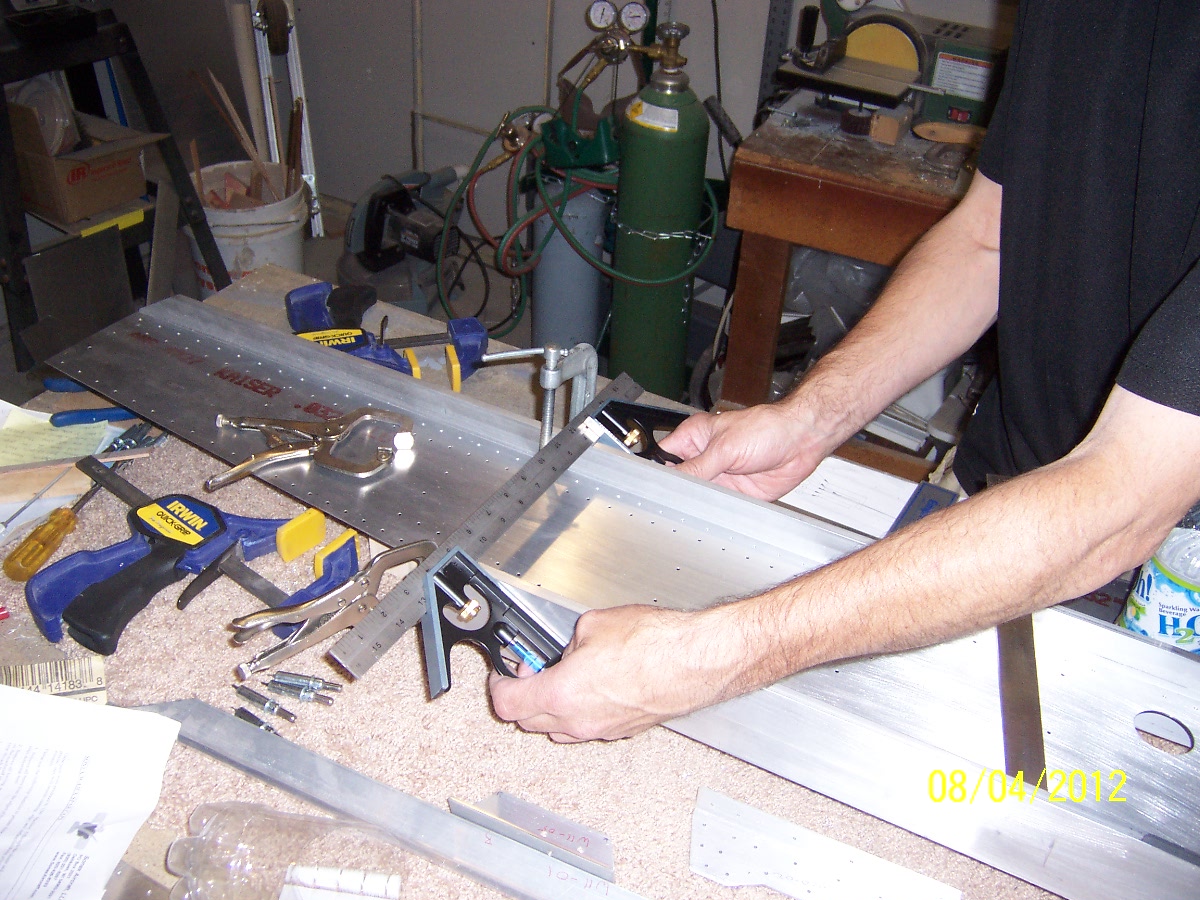
Sonex sells (or we could make) precision spacers that fit between the spar caps, but we would be depending on the precision of the spar cap “T” leg dimension. Another side note is that the match drill holes are in the spar web, so they need to be on top. This makes the spar caps’ “T” leg on the bottom underneath the spar web .
Our method measures the outside distance which is the dimension shown in the plans. We double-check setting the gap between the squares with a precision ruler and with a 8″ digital mircrometer that I borrowed from work. Since we are measuring an outside distance there is some feel to it. There is some friction, or tightness, of our outside gauge against the spar caps. We tried to be consistent with the same amount of drag feel of the gauge. You can easily have the gauge not perpendicular to the caps. To help this we would put pen marks on the caps with a square so we could line the gage up with them.
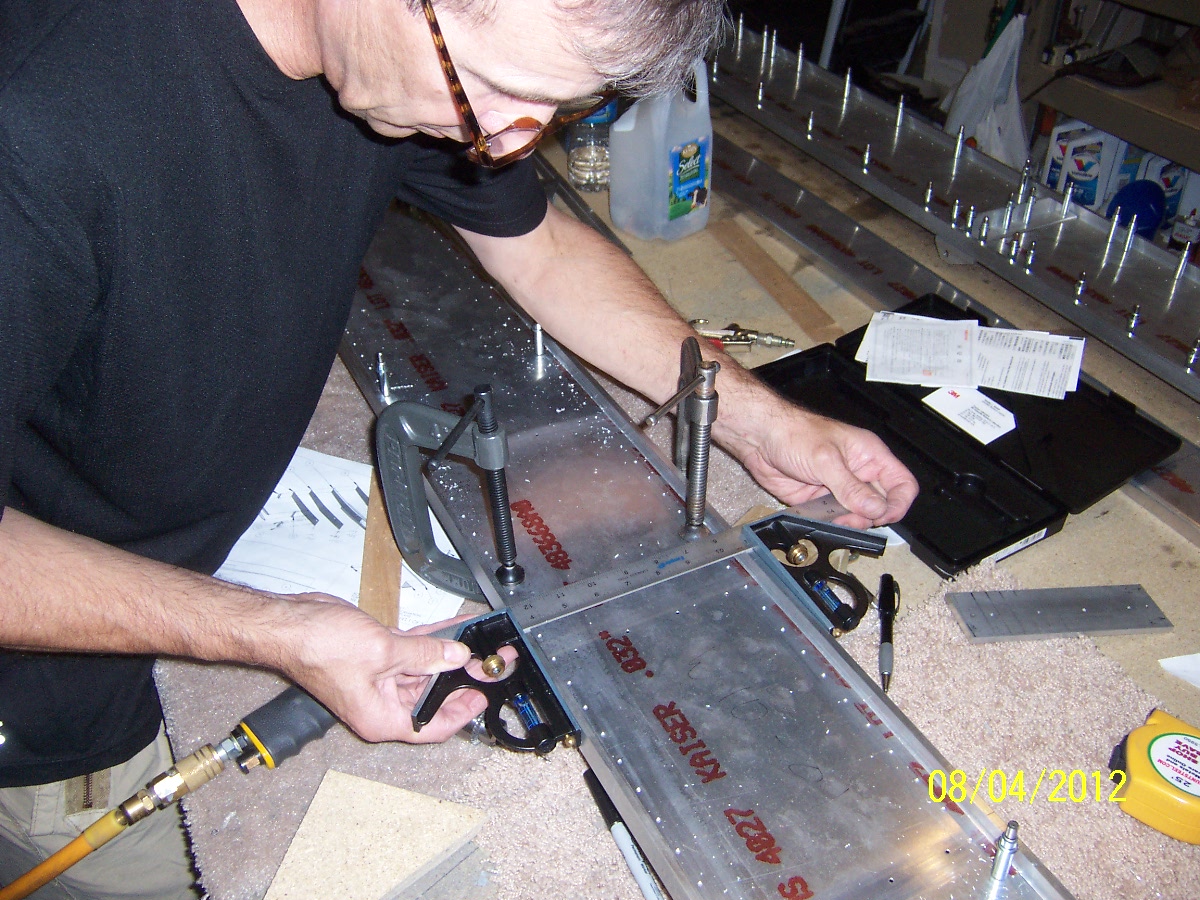
We would clamp the spar caps on the spar web and check the distance with the gage. The next step is to make sure the spar web is centered with respect to both caps. This took some iterations, but it got easier with two people.
Once the we felt the caps were clamped in the right place we drilled and clecoed one end , then the the end, then the middle. We kept splitting the distance to be in the middle of the gap. After about six times of this we just match drilled the rest.
To get a good perpendicular drilled hole we place a block of aluminum on the spar web next to the drill bit. By using the two edges of the corner it helps us see if the bit is off in either angle.