
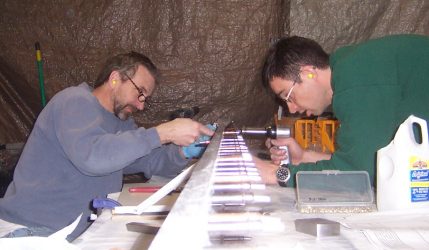
Details of constructing and using a web former is shown with the “tip rib” on the rudder (T10-04) as well as the leading edge rib (T10-05) on the rudder. This describes how we did it, certainly not the only way to construct a rib former and “bang out a rib” but it’s a record of the process we used.
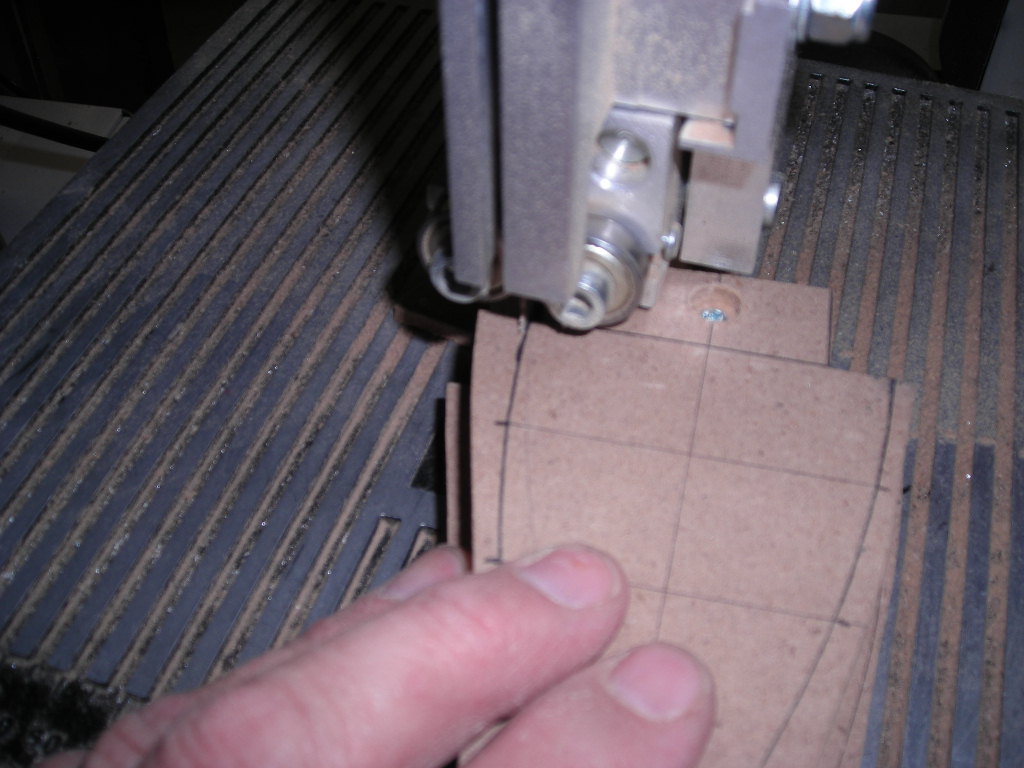
The Sonex drawings provide enough information to generate an accurate drawing of the rib former dimensions. You could use a protractor and ruler to carefully draw out the part or use the full size dimensions on the drawings but we did not want to “mess up” the drawings too much and start cutting them up unnecessarily so I simply used the dimensions on the drawings and used AutoCad to generate a paper part. Plotted the CAD drawing (making sure the scaling was correct) and cut the plotted part out to use as a marking guide to (finally) cut the blanks.
I used 3/4″ MDF (medium density fiberboard) for the blanks and add “tabs” to the end of the original drawing so I could hold the blanks securely while forming.

The end result after forming is a usable “Rib” (typically) that matches the original drawing.
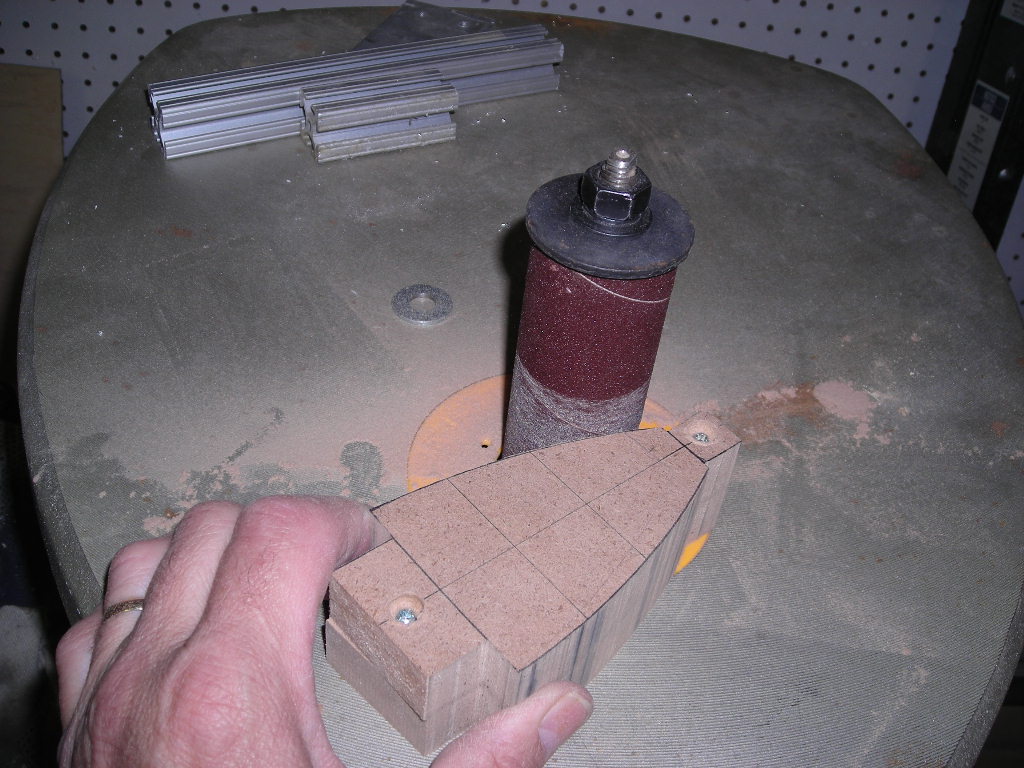


Web “Former” construction is basically the process of constructing an assembly of blocks used to clamp a “blank” of aluminum, cut to the final size needed for a rib. The former is used as a “bend guide” for the aluminum.