
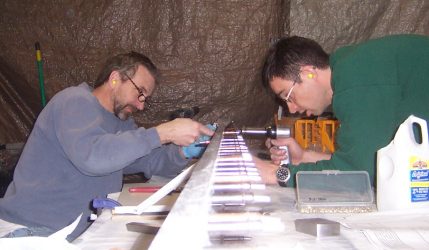
As mentioned, assembly of the rudder was moving along fine until it became apparent that the ruddder was not “square” with the world. My (Dan’s) thought is that this issue is somewhat easy to avoid but just as easy to fall into if you are not careful. The bottom line is that the rudder structure, like the wings, elevators, ailerons and flaps are thin ridgid structures that are expected to be “straight” when assembled. The geometry of the shape suggests that drilling the holes for assembly needs to be done carefully so as not to create a potato chip (warped wing) affect with the final product. A first order analysis of a 3 dimensional box shows how sensative the final shape is to the initial dimensions. If the one leg of a 2-1/2″ x 37″ rectangle is extended by 1/16″ the resulting shape (a rhombus) when coupled to a 3 dimensional assembly will be forced to satisfy the simultaneous relationship of each perspective side. If you attempt to adjust one perspective into a particular orthoganal alignment it will affect one or both of the other associated perspective views. Since the sheet dimensions are fixed (it is unlikely you will distort the sheet in its “x and y” dimensions) the sheet must accommodate the change by shifting in the “Z” dimension. How far will the part move in the Z dimension? A first order guess would be if the long side of a 2″ x 32″ rectangle is adjusted by 1/16″ the far end will raise by the ratio of 32/2 or 16 times the 1/16″ which is a full 1″.
All of this is somewhat accademic but points out what I mentioned to Tim in an E-mail that, while it is important to measure, mark and cut parts as close as possible, it is the assembly process and “rigging” of each part during assembly that defines the “trueness” of the plane. In other words, you can produce precision ribs and spars for the wings, for instance but when the skin is attached to the wing it is very easy to imagine (for me anyway) how the wing could be “warped” and just as easy to imagine how a slightly less than perfect wing structure could be properly rigged when the skin is match drilled to the ribs to obtain a straight wing.

This relatively small adjustment in the match drilling, shown above, was responsible for a rudder that was close to an inch out of “plane” (no pun intended) when sitting on a flat table surface. The cause was the slightly out of square original sheet that was bent into the basic shape and then held in edge alignment through the trimming and assembly process.
The correction was not large and the slight offset in the otherwise very perfect rudder was absorbed when up-drilling to the #30 bit size. A close call and a very valuable lesson.