Dan took on the task of using the fly cutter to cut out the lighten holes in all the ribs. Dan mentioned he clamped and braced one side of the rib against the post of the drill press. (Make sure no clothing can get caught in the fly cutter.)


Building An Airplane From Plans
Dan took on the task of using the fly cutter to cut out the lighten holes in all the ribs. Dan mentioned he clamped and braced one side of the rib against the post of the drill press. (Make sure no clothing can get caught in the fly cutter.)
We cut out the ribs with the electric shears, but it cannot get the bend corners. We deceded to use a router for the final rib shape.
Here Dan is creating a form block to use on the router. Using the washer trick from the Sonex class to get the flange distance. Note the angle perpendicular to the curve at the corner cut outs. This makes the flange correct once you bend it over.

Here is a rib in the form block after the router:

Here is a top of the form block off:

Here is a stack of routered ribs:

Dan marked up some sheets to cut out the forward and aft ribs. In the first picture you can see some damage to the sheet. When we picked up the material at the vendor the forklift operator let the tines contact the sheets. Now we are noticing the damage. Oh well we work around it.

B

C

D

The following series of photos shows the steps we used to cut oval holes on the W13 parts. The photos need little explanation.

Center of offset circles to make up the oval

Clamps and clecos with aluminum scrap below to keep part in place while drilling

First hole complete

Drilling the second hole

Second hole complete

Skipped a bunch of steps but photo of finished W13-01R part
The Sonex workshop (no charge to attend when you buy plans) provides a good opportunty to form a wing rib. The difference between the workshop and making one in your garage (hanger or basement) is that all the preparation is completed in the Sonex workshop and need to make all the preparation and associated decisions in your garage. And, most importantly, the rib you make at the Sonex workshop will not go into the plane you are building. In reality, builing ribs is one of the easier tasks of scratch building. It’s just that there are enough of them (52 total on the wings) that you really want to follow a path that is efficient and produces a quality part.
The starting point for the rib, is of course the rib former. We purchased the rib forming kit from Sonex. The most obvious thing you notice when you inspect the kit upon delivery is the fact that the user (that’s you) needs to make the second half of the formers. This is not a big deal as you can easily pick up some particle board (3/4″ or 5/8″) and trace out a backup former (the manual calls it a “crush plate”).
If you read the outline of steps in the documentation provided with the plans (SNX-W15.1) mentioned above, the procedure instructs you to cut the crush plate approximately 3/8″ smaller than the form block. This point is interesting because I don’t recall the crush plate we used at the workshop being smaller (I’ll admit it might have been smaller and I simply did not notice) and all the form block sets I have made from scratch for the horizontal and veritcal ribs have been matched sets (i.e. no 3/8″ smaller size for the crush plate).
I can see advantages to both making it smaller and having matched form blocks but I thought that I would build one rib with the crush plate made full size and see how it turns out. I could always cut it down to the 3/8″ smaller size.

The rib former set is shown (above) before the fluting grooves are added to the new form block. The lighter colored block is the one from Sonex and the darker is the one I made. The difference is the Sonex block is from particle board and mine is MDF (medium density fiberboard). The MDF provides a smoother surface to bend parts on but it is a MESS to cut and sand. Both will work.
Cutting the rib blank is the first step and as has been documented in numerous web blogs, there are multiple alternative methods to cut blanks. The simplest is to use a washer to trace out the blank around the form block. The oveall procedure is:
1) Rough cut a “rib blank” slightly larger than the final size needed (approximately 1/2″ or more larger than the rib former dimensions, on all sides)
2) Drill the 1/4″ holes in the rib blank , using the former as a drill guide.
3) With the rib blank located between the two formers and held in place with the 1/4″ bolts that pass throught he formers and the blank, use a sharpie to marke the rib blank outer edge to be cut (use a washer with a 1/2″ material width between the inner hole of the washer and the outer diameter to guide the sharpie).
I found that once marked and rough cut, I could trim the rib blank very close to the marked line with a band saw and then using the vixen file to trim the edges followed up with 120 grit sand paper to smooth out the file marks.
The alternative of making an oversized pattern out of your favorite scrap material and using a router to cut the blank to size is something to be considered. Since there are 26 of these blanks to cut it could be a time saver in the long run. In particular, the corners could be cut much more quickly with the router method and trimming and de-burring these corners takes more time than the entire perimeter. Obviously, whether cutting with the band saw or using the pattern and router method, a lot can be gained by cutting more than one rib blank at a time. Using the router method would amplify the advantage with regard to the time it takes to finish off the corners (drilling, trimming and filing the corners takes a lot of time)
The next is to cut the lightening holes. Again, some have done this as part of the router cut process. It takes some care but it is not at all difficult to do this with a flycutter and a drill press. One thing I noted is that on the aft rib I had to use the larger of the two drill presses in the shop (Tim’s). The smaller cheesy “Tool Shop” drill press (mine) did not have the distance needed from the support post to the drill mandrill and the blank could not be drilled far enough in to reach the proper location for the 4″ holes.
No photos of the rib blank just before forming.
Rib forming is pretty easy on the large ribs on the wings (as compared to the ribs for the vertical and horizontal stabs). I have found that using the fluting plyers to just start a flute prior to forming seems to help. After forming all four sides the removing from the form blocks the rib takes on quite a bend (as shown in the blurry photo below).

The standard process of carefully increasing the flutes to straighten the sides along with pressing the rib flat down on the bench with your hand (flanges up, of course) and tapping the flanges until they are at right angles to the plane of the bench. I adjust the flutes slightly to straighten the flanges and then flare the lightening holes before going back and working the flutes again to get the rib to lay flat.

The entire rib forming process (after blank is cut, de-burred and the lightening holes added) was about 20 minutes max. , which included flaring the lightening holes. I’m sure this time could be reduced (maybe I did not keep track of my time well and it was less) but even if you could get it down to 10 minutes per rib, with no breaks it will still take over 8-1/2 hours of straight work to form all 52 forward and aft ribs for the wings. And that is after they are cut and deburred. Kind of makes buying the ribs from Sonex seem like a deal. But then again, we don’t do this to make money but rather to enjoy the process of learning and doing.
The parts from W13 – Rear Spar Details

W13-01R

W13-01L

W13-04

W13-02L

W13-02R

W13-03
Dan drilled the Wing Attach Block, W10-03, to the End Attach Angle.
A

B

C

D

E

F

G

H

I
Dan and I discussed at length (remember we are engineers) how to mark all the holes on the 141″ long W10-01. We have a 12″ and 36″ steel rules supposably accurate rked to the 1/64 . So one could start at one end and make a make a mark near the end of the rule and move the rule down to that mark and keep going. Trouble with this method is “accumulation of error” or “error stack up”. Say you are off by 1/64 (.015″) on the first rule move, and then the second move is right on, but the third is another 1/64 (.015″), and the fourth is another 1/64 off. (Now before you repremand me to be more accurate, try to mark and then reposition to a 1/64, it’s take time and a good set of eyeballs.) Anyway the holes on your fourth ruler interval are off by the accumulated errors since they are all dependent on the previous set. So those holes are off by 3/64″ (.045″), hmmmmm. Does it matter? I don’t know, but would like to be as accurate as we can.
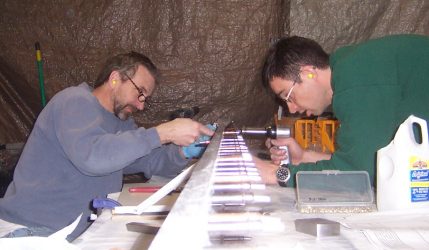
So when we thought about going 141″ we wanted to try something different. We decided to make a drill template and move the template along the spar (picking up the last hole drilled by the template.) We made the template the distance between the ribs which is 10″. Now the error will depend on the accuarcy of the template, but we have access to a Bridgeport mill at work so we used that for the hole accuracy. So basically the template had the rib holes 10″ apart and all the 1″ holes in between. We put flange on one side so it would mate against the spar top (or bottom) and the holes would be the the right distance. Here is a picture of the template:

We had marked the 10″ intervals with the rule also, but the template would be the guide. Now that we had the top and bottom holes of the ribs, we made another drill template for the rib holes in between. This template was cleco-ed to the top and bottom and provided the middle holes

We went back with the first template and drilled the holes between teh ribs:


Now that is a lot of holes.
We drilled the holes for the wing tip attachment, W10-04. Aligned the top edge and the right length.

We used the first template for the top holes:

Here is the angle, W10-06 on the wing tip attachment W10-07:

The left and right front spars overlap as can be seen in W08 Detail K. In the overlap region there are 5 accurate holes that line up. If you look later in the plans only the outside two bolt the two spars together. The middle three are used as alignment holes when you drill the outside ones to each other and the fuselage. When making the main spar webs, W10-01 the plans note to layout and drill these hole accurately.
So given the accuracy of marking and then drilling what is the likelihood that all 5 sets of holes will line up exactly. Well Dan and I discussed this at length and this is what we came up with. Any two sets of holes will define the two spar webs and the rest of the holes will just over constrain the parts. Think of it this way, you overlap the two spars as shown in the plans, you put a pin in one set of the 5 holes that line up. Now you cannot move the two spars in X and Y directions the only degree of freedom left is rotational. So now you can rotate the spars until another set of the 4 holes (that are left) are aligned. Put a pin in those two aligned holes. Now the two spars are fully constrained to each other and if the final 3 sets of holes line up GREAT, but if they don’t there is nothing you can do about it. Given the accuracy of marking and drilling it is easy to be off by a 1/64 of an inch, which is .015″. Now on a #40 hole (.098″ dia) that 64th of an inch is 15% and will be noticeable by eye. But that is in just one direction (X) you could be off in the other (Y) also.
Now I know that these holes will be up drilled at a later date so maybe it doesn’t matter. But here is what we did. We drilled the two outside holes of the 5 “wing attach” on each spar web as accurately as we could. We then flipped one spar round and clecoed them together as they are layed out in the final assembly using the outside holes. Now we match drilled the 3 middle holes through the two webs. Now all 5 sets of hole will line up since the middle 3 were “aligned” by the outside 2.
Are we over thinking this? Probably. Are we engineers? Yup.
Here are the two spar webs aligned by the two outside clecos

Here we are checking the angle:

Checking the overlap on the bottom:

August – Finishing the spar andgle parts

Spar Parts In Progress
Marking the holes in W10-01. This took a while, wanted it to be accurate since it is the template for the other webs

Some progress on the spar parts:

Fiinshed up the Spar Parts