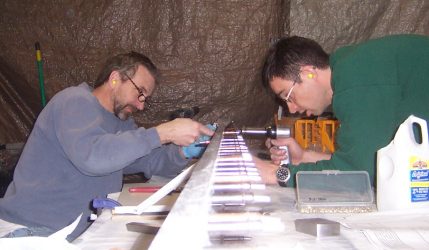
The Sonex workshop (no charge to attend when you buy plans) provides a good opportunty to form a wing rib. The difference between the workshop and making one in your garage (hanger or basement) is that all the preparation is completed in the Sonex workshop and need to make all the preparation and associated decisions in your garage. And, most importantly, the rib you make at the Sonex workshop will not go into the plane you are building. In reality, builing ribs is one of the easier tasks of scratch building. It’s just that there are enough of them (52 total on the wings) that you really want to follow a path that is efficient and produces a quality part.
The starting point for the rib, is of course the rib former. We purchased the rib forming kit from Sonex. The most obvious thing you notice when you inspect the kit upon delivery is the fact that the user (that’s you) needs to make the second half of the formers. This is not a big deal as you can easily pick up some particle board (3/4″ or 5/8″) and trace out a backup former (the manual calls it a “crush plate”).
If you read the outline of steps in the documentation provided with the plans (SNX-W15.1) mentioned above, the procedure instructs you to cut the crush plate approximately 3/8″ smaller than the form block. This point is interesting because I don’t recall the crush plate we used at the workshop being smaller (I’ll admit it might have been smaller and I simply did not notice) and all the form block sets I have made from scratch for the horizontal and veritcal ribs have been matched sets (i.e. no 3/8″ smaller size for the crush plate).
I can see advantages to both making it smaller and having matched form blocks but I thought that I would build one rib with the crush plate made full size and see how it turns out. I could always cut it down to the 3/8″ smaller size.

The rib former set is shown (above) before the fluting grooves are added to the new form block. The lighter colored block is the one from Sonex and the darker is the one I made. The difference is the Sonex block is from particle board and mine is MDF (medium density fiberboard). The MDF provides a smoother surface to bend parts on but it is a MESS to cut and sand. Both will work.
Cutting the rib blank is the first step and as has been documented in numerous web blogs, there are multiple alternative methods to cut blanks. The simplest is to use a washer to trace out the blank around the form block. The oveall procedure is:
1) Rough cut a “rib blank” slightly larger than the final size needed (approximately 1/2″ or more larger than the rib former dimensions, on all sides)
2) Drill the 1/4″ holes in the rib blank , using the former as a drill guide.
3) With the rib blank located between the two formers and held in place with the 1/4″ bolts that pass throught he formers and the blank, use a sharpie to marke the rib blank outer edge to be cut (use a washer with a 1/2″ material width between the inner hole of the washer and the outer diameter to guide the sharpie).
I found that once marked and rough cut, I could trim the rib blank very close to the marked line with a band saw and then using the vixen file to trim the edges followed up with 120 grit sand paper to smooth out the file marks.
The alternative of making an oversized pattern out of your favorite scrap material and using a router to cut the blank to size is something to be considered. Since there are 26 of these blanks to cut it could be a time saver in the long run. In particular, the corners could be cut much more quickly with the router method and trimming and de-burring these corners takes more time than the entire perimeter. Obviously, whether cutting with the band saw or using the pattern and router method, a lot can be gained by cutting more than one rib blank at a time. Using the router method would amplify the advantage with regard to the time it takes to finish off the corners (drilling, trimming and filing the corners takes a lot of time)
The next is to cut the lightening holes. Again, some have done this as part of the router cut process. It takes some care but it is not at all difficult to do this with a flycutter and a drill press. One thing I noted is that on the aft rib I had to use the larger of the two drill presses in the shop (Tim’s). The smaller cheesy “Tool Shop” drill press (mine) did not have the distance needed from the support post to the drill mandrill and the blank could not be drilled far enough in to reach the proper location for the 4″ holes.
No photos of the rib blank just before forming.
Rib forming is pretty easy on the large ribs on the wings (as compared to the ribs for the vertical and horizontal stabs). I have found that using the fluting plyers to just start a flute prior to forming seems to help. After forming all four sides the removing from the form blocks the rib takes on quite a bend (as shown in the blurry photo below).

The standard process of carefully increasing the flutes to straighten the sides along with pressing the rib flat down on the bench with your hand (flanges up, of course) and tapping the flanges until they are at right angles to the plane of the bench. I adjust the flutes slightly to straighten the flanges and then flare the lightening holes before going back and working the flutes again to get the rib to lay flat.

The entire rib forming process (after blank is cut, de-burred and the lightening holes added) was about 20 minutes max. , which included flaring the lightening holes. I’m sure this time could be reduced (maybe I did not keep track of my time well and it was less) but even if you could get it down to 10 minutes per rib, with no breaks it will still take over 8-1/2 hours of straight work to form all 52 forward and aft ribs for the wings. And that is after they are cut and deburred. Kind of makes buying the ribs from Sonex seem like a deal. But then again, we don’t do this to make money but rather to enjoy the process of learning and doing.
Return To Wings – Ribs