
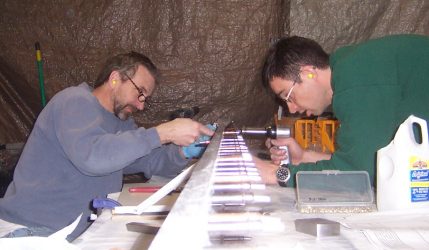
We like the look of the flush rivets. Although is probably only gains a couple MPH I think it looks really sleek.
To use the flush exterior rivest means you have to dimple the skin and the underlying part.
December 29th and 30th, 2010.
Tim and I have been vacillating over the issue of how best to dimple for flush rivets. Tim purchased a “C” frame, used from an RV builder, and once adjusted it works well but not everything will fit in this tool. While it has a 24″ throat some things need to be dimpled with one of the hand tool methods of dimpling. We purchased a couple copies of the Sonex dimple dies and they are OK but we did not like a couple things about them.
1) The 6d finish nail does not fit tight at all around the dies which allows them to wander and tip when used. The result is most of the time the dimple is quite asymetrical.
2) The die we received from Sonex is a little deeper than is necessary and so the rivet sits way below the surface of the skin.
I spent one evening experimenting with the die and could resolve one of the problems (the loose fit around the die to nail) by using a 10d finish nail instead of the 6d, which helped keep the dimple very symetrical. The only problem is that when I pilot drill with a 1/8″ or #31 drill bit and then use the dimple die the resulting hole after dimpling is enlarged dramatically and the rivet almost does not contain the lower sheet when pulled.
So Tim and I spent an afternoon messing around and trying to understand the effect of larger and smaller pilot holes on the end result. The procedure we used is certainly not the last word on the subject but it gave us the confidence to pick a path and move forward. What we did was to produce samples of 0.025 sheets flush riveted together with different drill sizes and dimple methods and then cut and grind the rivet nearly in half, exposing a cross section of the rivet and aluminum sheet and then using muratic acid we would etch the cross section to provide better contrast between the layers of aluminum and the rivet.
The photos below are representative of what we found observed.

It was very interesting to see what occurs at the “inside” of the rivet.

The sonex die using a 1/8″ pilot drill bit on the left creates such a large hole after dimpling that the rivet “bulb” is pulled past the lower sheet. (Not very encouraging). It would be interesting to test this type of rivet method for the point of failure and compare it to some of the others. We know that looks can be deceiving but it is hard to believe that this is a strong rivet. Note that while we used a 10d finish nail as the pull tool for the Sonex die, we feel this only improves the quality of the dimple as it keeps the die centered on the hole. The right side shows the result of using the C frame for the top dimple and the Sonex die for the bottom. In this case the Sonex pilot hole was likely a #40 but we did not document this detail.

This last photo shows (on the left) the method we will adapt when using the Sonex dimple die, which is to leave the pilot hole at the #40 size, dimple and then after dimpling, updrill for the CCC42 rivet. The primary advantage is that the hole is not enlarged too much when dimpling and in fact needs to be updrilled so the rivet will fit. The resulting snug fit with the rivet creates a large gripping force with the rivet ball and pulls the two sheets tight together.
On the right you can see the protruding rivet and how it compares to the flush rivets.
The one thing not discussed above was the fact that the Sonex dimple die, for all its advantages is made with a center hole that (in our humble opinion) is MUCH TOO LARGE. Our options were to go out and try to find a better dimple die (other vendors sell similar tools at much higher prices than Sonex), make one ourselves, or modify the Sonex die. We took a shot at modifying the Sonex die. The first thing we did was to wrap some aluminum tape around the stem at the very bottom of the nail so the lower half of the die would stay centered on the 6d finish nail. This is appeared to be an improvement on the die but the top half still has a tendency to be off center when dimpling and creating an asymmetrical dimple. (Later on I mention on theory I have that would lead me to believe this change to restrict the bottom half is not an advantage. In fact, it could be that locating the top half alone would be sufficient to improve the Sonex die.) Our solution was kind of a back yard fix but it worked and at some point we need to find out from Sonex Inc. why they drill out their dimples to such a large diameter.
The ultimate Sonex (not so super simple) dimple die. I think that if John Monnett ever reads this he will just shake his head in disgust. From his perspective I would expect he would consider it a day we spent improving something that was plenty good enough…..
The solution was to (simply) construct a bushing for the center of the die on the top and bottom halves. I think we did this the hard way but it worked. We took a 1/8″ brass rod. cut it to a length of about 0.120″ filed the ends flat, and then center drilled the 1/8″ rod with a (very sharp) 3/32″ bit and then updrilled to a #40. We then heated one half of the dimple die with a hot air gun and unitl the center hole expanded to a little over 0.125″ and then (quickly) pressed the little brass bushing into the die with our bench vise. We did this once for each half of the dimple die. After pressing the brass bushings into the die halves and letting it cool, we had to updrill the hole back to a #40 so it would fit onto the 6d finish nail.

We did a reasonable job on the first try but took 4 more tries to get the second one close enough to a concentric hole to satisfy ourselves. We had 36″ of 1/8″ brass rod from our local hardware store so we were more likely to give up than run out of material…..


Notice the washers added to the nail head. This was done from the first day we tried the die and was not mentioned previously. The idea is to insure the nail head does not get pressed onto the die but in all fairness, if you are using that much force you need to recalibrate your grip. We have found that there is little need to use anything but a hand rivet squeezer for dimpling as the required force is very light and the pneumatic rivet gun is completely unnecessary. If you feel the need to use it, the pressure needs to be turned very low (maybe 15 psi?) when dimpling or you will simply pull the head through the dimple die.
As can be seen in the photo, the nail has been used a few times and is expected to be replaced from time to time.
Finally, notice the aluminum on the male die. We found that the Sonex die we received created a dimple that was much too deep and so we added 4 layers of 2 mil aluminum tape to reduce the depth of the dimple. This was done by using an office hand punch to produce a ~1/4″ hole in consecutive pieces of tape and laying the tape over the male die and folding around the sides. It was trimmed straight for aesthetics.


Notice that the ball of the rivet stem is held below the lower sheet metal layer, much like the protruding rivet did. Also, because the pilot hole is only a #40 and the dimpled hole needs to be updrilled for the rivet, the resulting sidewall on the sheetmetal is straight and more importantly, is a smaller necking point for the rivet to pull against.
Final analysis:
It may be unfair to not bring up some details in the comparison between the original Sonex die and what we are now using. First, I pulled a completely virgin Sonex die from the package and took some measurements. The id of the center hole is very close to what we had before modification; 0.117″ on the male half and 0.120″ on the female half. It should be noted that the original nail Sonex provided is on the large side of a 6d finish nail at 0.102″ which helps a bit in the centering of the die. I recall when I first opened the die and began using it the first thing I did was compare the nail with other finish nails I had around and probably inadvertantly swapped the thicker one for a thinner one I had on hand when I added the washers to the head. It is fortunate from my perspecive because the smaller nail I am currently using has an o.d. of 0.092″ and so fits easily into a #40 pilot hole.
The depth of the die is still too great and measures 0.046″ from the base of the male end to the tip of the dimple protrusion. This is where we added 8 mils of aluminum tape to reduce the height to 38 mils total, which fits the CCC-42 rivets better by not counter sinking the rivet so far below the skin. In again, in all fairness the 8 mils is not all that much but it does definitely keep the rivets well below the surface of the outer skin. Maybe that was the intent. I think the target is +/- 2 mils from the surface though.

The side ways positioning of the Sonex die lower half is a measure of the amount of available misalignment of the die from the center of the nail which is in the range of 19 mils for the bottom half and 14 mils for the top half. I suspect the top half might be desinged to be a tighter fit to allow the bottom to align to the location of the top. Unfortunately, this large tolerance allows the die to tip when dimpling as well as being off center from the pilot hole. The result is an ugly dimple. It would be a simple fix to reduce the I.D. of the die and simply supply or identify a need to use thin 6d nails as there is a wide variation in nail diameters available on the market and there is an advantage in using a nail small enough to fall into a #40 pilot.
As a final comparison I took the spankin new Sonex die and dimpled some holes in 0.025 aluminum next to dimples made with the modified die. Of course on the modified die, I pilot drilled with #40 bit dimpled and then updrilled to #30. On the Sonex dimple I first used what I knew would produce the best final hold and so I pilot drilled up to #34 and then dimpled the hole. The result is a very nice dimpled hole that expands to something near the size a #30 bit would make so the CCC-42 rivet fits in the hole. Then I recalled that clecos do not fit in the #34 hole so it is not really a viable alternative when match drilling so I drilled two #30 holes next to the #34 holes and dimpled these.
The resulting hole after updrilling / dimpling is this. The modified die holes came out to 0.124″ – 0.126″, which is what you’d expect as the last step was to updrill these using a #30 bit. The Sonex holes that were first updrilled to a #30 resulted in final holes after dimpling of around 0.143″ – 0.145″. I think this example of the virgin Sonex die is much better that we were seeing before we modified our die but it is possible that the first die was showing the ravages of wear, even though has not been used all that much. While these holes are from a die in very good condition.

- Modified die on bottom 3 holes, top holes are done using original Sonex die with 2nd and 4th from right done with #30 drill bit which would be required for proper cleco assembly
- One final link for those that have not had enough of all this talk about flush rivets:
http://www.youtube.com/watch?v=5DVPG8go4Jk Hope the link is still good
- Here is a table with some of our results for 1/8″ flush rivets (remember for a dome head 1/8″ rivet we drill to a #30 which is .1285″ diameter):
| Hole Dia | Cleco Fit | Avery 120 deg die | Sonex Super Simple Dimple Die, Shimmed |
| #40 (.098) | 3/32″ Silver | Stuck on Die, Too Tight | 6p Nail, Good Dimple, Needs Up Drill To 1/8 or #30 |
| #32 (.116) | None 3/32 Loose, 1/8 Not Fit | ||
| #31 (.120) | 1/8″ Copper | Good Dimple, .128 Dia, .001+ proud of surface | |
| 1/8 (.125) | 1/8″ Copper | Good Dimple, .130 Dia | 6p Nail, OK Dimple, Can be off center & angled |
| 10p Nail, Better Dimple, Large dia .140 Bore | |||
| #30 (.1285) | 1/8″ Copper | Good Dimple, .135+ Dia |