
12/28/2013
The entire day was consumed with fitting and then mounting the left wing tip. I have been getting started no sooner than about 11:00 and the evening often is consumed with the dinner meal and guests (Chele’s sister and husband often but all three boys are home for Christmas break so a break for dinner is a guarantee). If we have company (which is usually restricted to Fridays and Saturdays) then my day is over by 5:30.
Nut plates on fiberglass wing tips;
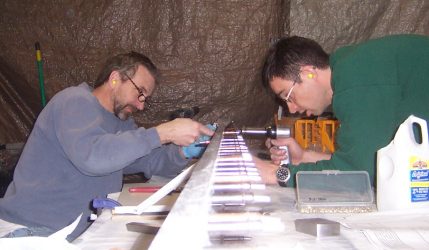
I have the procedure for installing nut plates for flush screws down pretty well. With the fiberglass (f.g.) tip parts there is a need to counter sink (c.s.) the f.g. To accept the dimple of the skin for the flush screws. This dimple, even for the small #6 screws, is pretty a deep c.s., considering the f.g. is only 0.100″ to 0.140″ thick. I was thinking of using solid rivets to anchor the nut plates but after the first few showed consistent cracking of the gel coat, regardless of how I set the squeezer. Pull rivets are more expensive and a little fast due to the time needed for cutting the rivets (all I have are -35 solid rivets and they need to be cut to around. 0.280″ ). I have a few photos to show the cracking and the overall process.
A large portion of the fitting time for the tip is spent trimming, checking and re-trimming the skin to the right length and contour. Once the skinned is trimmed for an acceptable fit, the 1/4″ and 3/8″ setback for the screw holes is marked from the edge. I actually moved the screw centers away from these dimensions (which are what the Sonex plans denote for rivets) by about 1/16″.
Once the screw holes are marked an drilled, the rest of the process is defined and routine. The tip requires 42 nut plates ( not including the face) and so there a lot of holes to drill and c.s.
The first rough cut of the skin is done with my ( invaluable ) electric shear. I bought the shear on sale for $39 at Menards (Tool Shop) and have seen nearly the identical tool with other vendors under other names such as “Klutch” for as much as $89. Quality tools of this design are closer to $200 but after using it to cut ribs and skins on the project I would not want to tackle a “plans built” metal plane without it.
After the rough cutting the rest of the cutting is done with a vixen file. I still need to add a little fiberglass to the tip near the leading edge but I will wait and mess with both wing tips at the same time.
Next, it is time to finish the root doubler and updrill the top skin.


