Finally a complete empennage picture. We have had the parts done for a while and Dan took this great picture.

This was a great milestone to see.

Building An Airplane From Plans
Finally a complete empennage picture. We have had the parts done for a while and Dan took this great picture.
Dan took on the task of using the fly cutter to cut out the lighten holes in all the ribs. Dan mentioned he clamped and braced one side of the rib against the post of the drill press. (Make sure no clothing can get caught in the fly cutter.)

We cut out the ribs with the electric shears, but it cannot get the bend corners. We deceded to use a router for the final rib shape.
Here Dan is creating a form block to use on the router. Using the washer trick from the Sonex class to get the flange distance. Note the angle perpendicular to the curve at the corner cut outs. This makes the flange correct once you bend it over.

Here is a rib in the form block after the router:

Here is a top of the form block off:

Here is a stack of routered ribs:

Dan marked up some sheets to cut out the forward and aft ribs. In the first picture you can see some damage to the sheet. When we picked up the material at the vendor the forklift operator let the tines contact the sheets. Now we are noticing the damage. Oh well we work around it.

B

C

D

Looking at all the ribs to make and all the long cuts to do, Dan purchased an electric shear. The tool is wonderful, it eats .025 aluminum easily. There is some technique to using it, and it wastes ~1/4″ strip between the cuts. It makes life so much easier and you don’t get the scallops form the big grey hand shears.

A

B

C
The parts from W13 – Rear Spar Details

W13-01R

W13-01L

W13-04

W13-02L

W13-02R

W13-03
Dan drilled the Wing Attach Block, W10-03, to the End Attach Angle.
A

B

C

D

E

F

G

H

I
I had ordered and received replacement crankshaft-connecting rod bearings. Dan and I took a couple hours to put the compressor back together. Dan had some STP type stuff to put in the bearings during assembly. We put the flapper plates back together, bolted it all together, filled it with oil, put the fly wheel on, and …. it works and it is much more quiet. So far so good. The worn bearings must have been rattling around.
Dan and I discussed at length (remember we are engineers) how to mark all the holes on the 141″ long W10-01. We have a 12″ and 36″ steel rules supposably accurate rked to the 1/64 . So one could start at one end and make a make a mark near the end of the rule and move the rule down to that mark and keep going. Trouble with this method is “accumulation of error” or “error stack up”. Say you are off by 1/64 (.015″) on the first rule move, and then the second move is right on, but the third is another 1/64 (.015″), and the fourth is another 1/64 off. (Now before you repremand me to be more accurate, try to mark and then reposition to a 1/64, it’s take time and a good set of eyeballs.) Anyway the holes on your fourth ruler interval are off by the accumulated errors since they are all dependent on the previous set. So those holes are off by 3/64″ (.045″), hmmmmm. Does it matter? I don’t know, but would like to be as accurate as we can.
So when we thought about going 141″ we wanted to try something different. We decided to make a drill template and move the template along the spar (picking up the last hole drilled by the template.) We made the template the distance between the ribs which is 10″. Now the error will depend on the accuarcy of the template, but we have access to a Bridgeport mill at work so we used that for the hole accuracy. So basically the template had the rib holes 10″ apart and all the 1″ holes in between. We put flange on one side so it would mate against the spar top (or bottom) and the holes would be the the right distance. Here is a picture of the template:

We had marked the 10″ intervals with the rule also, but the template would be the guide. Now that we had the top and bottom holes of the ribs, we made another drill template for the rib holes in between. This template was cleco-ed to the top and bottom and provided the middle holes

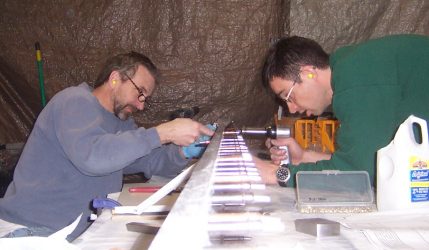
We went back with the first template and drilled the holes between teh ribs:


Now that is a lot of holes.
We drilled the holes for the wing tip attachment, W10-04. Aligned the top edge and the right length.

We used the first template for the top holes:

Here is the angle, W10-06 on the wing tip attachment W10-07:


