
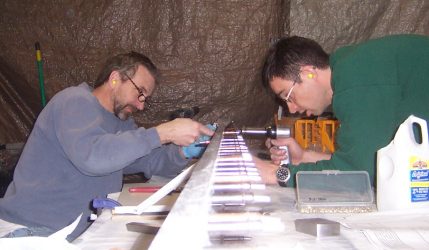
The left and right front spars overlap as can be seen in W08 Detail K. In the overlap region there are 5 accurate holes that line up. If you look later in the plans only the outside two bolt the two spars together. The middle three are used as alignment holes when you drill the outside ones to each other and the fuselage. When making the main spar webs, W10-01 the plans note to layout and drill these hole accurately.
So given the accuracy of marking and then drilling what is the likelihood that all 5 sets of holes will line up exactly. Well Dan and I discussed this at length and this is what we came up with. Any two sets of holes will define the two spar webs and the rest of the holes will just over constrain the parts. Think of it this way, you overlap the two spars as shown in the plans, you put a pin in one set of the 5 holes that line up. Now you cannot move the two spars in X and Y directions the only degree of freedom left is rotational. So now you can rotate the spars until another set of the 4 holes (that are left) are aligned. Put a pin in those two aligned holes. Now the two spars are fully constrained to each other and if the final 3 sets of holes line up GREAT, but if they don’t there is nothing you can do about it. Given the accuracy of marking and drilling it is easy to be off by a 1/64 of an inch, which is .015″. Now on a #40 hole (.098″ dia) that 64th of an inch is 15% and will be noticeable by eye. But that is in just one direction (X) you could be off in the other (Y) also.
Now I know that these holes will be up drilled at a later date so maybe it doesn’t matter. But here is what we did. We drilled the two outside holes of the 5 “wing attach” on each spar web as accurately as we could. We then flipped one spar round and clecoed them together as they are layed out in the final assembly using the outside holes. Now we match drilled the 3 middle holes through the two webs. Now all 5 sets of hole will line up since the middle 3 were “aligned” by the outside 2.
Are we over thinking this? Probably. Are we engineers? Yup.
Here are the two spar webs aligned by the two outside clecos

Here we are checking the angle:

Checking the overlap on the bottom:


